What Is a Sacred Vietnamese Architecture Tattoo?
A sacred Vietnamese architecture tattoo is a body art style inspired by Vietnam’s spiritual and imperial structures such as pagodas, temples, and ancient citadels. These tattoos translate architectural harmony, religious symbolism, and ancestral reverence into visual storytelling. They are not decorative alone—they carry cultural identity, historical memory, and spiritual protection meanings rooted in Vietnamese heritage.
Information Gain Insight: Unlike generic “Asian temple tattoos,” sacred Vietnamese architectural tattoos are often built on real structural references from heritage sites. Artists frequently reconstruct roof curvature, gate symmetry, and ornamental carvings rather than copying photographs, making each tattoo an interpretive architectural translation rather than a direct replica.
Historical Roots in Vietnamese Temples and Pagodas
The historical foundation of sacred Vietnamese architecture tattoos comes from centuries-old temples, pagodas, and imperial complexes that reflect Buddhist philosophy and dynastic authority. These structures were designed not only for worship but also to express cosmic balance, hierarchy, and harmony between humans and nature.
One of the most influential references is the Temple of Literature in Hanoi, which embodies Confucian ideals of education, order, and reverence for knowledge. Tattoo interpretations of such sites often emphasize symmetry, layered rooftops, and courtyard depth to reflect intellectual and spiritual balance.
Expert Perspective: Tattoo artists specializing in Vietnamese architectural motifs often study real structural blueprints or on-site photography to maintain proportional integrity. This prevents the common mistake of “flattening” temples into generic pagoda silhouettes, which strips away cultural and architectural accuracy.
Symbolism Behind Vietnamese Sacred Architecture Tattoos
Sacred Vietnamese architecture tattoos symbolize spirituality, ancestral respect, protection, and cultural continuity. These designs are deeply influenced by Buddhism and folk spirituality, where temples and pagodas act as physical bridges between the human world and the spiritual realm. Each structural detail carries layered meaning beyond aesthetics.
Information Gain Insight: A frequently overlooked aspect is that Vietnamese sacred architecture often encodes social hierarchy and cosmology into its structure. Roof tiers, gate positioning, and directional alignment reflect not just beauty, but philosophical systems of order derived from Confucian and Buddhist worldview integration.
Spiritual Meaning of Temples and Pagodas in Tattoo Art
In tattoo interpretation, temples represent grounding, stability, and spiritual reflection, while pagodas symbolize enlightenment and ascension. Together, they create a narrative of personal growth and protection. Many wearers choose these motifs to signify resilience, ancestry honor, or life transformation journeys.
In Vietnamese culture, sacred spaces are also associated with ancestor worship practices. This adds another layer of meaning in tattoos, where the design becomes a symbolic homage to lineage and inherited wisdom rather than a purely religious icon.
Key Architectural Elements and Their Tattoo Translation
Vietnamese sacred architecture is rich in symbolic structural elements that translate effectively into tattoo composition. These include curved roofing systems, dragon-adorned ridges, stone gate entrances, and symmetrical courtyard layouts. Each element plays a role in storytelling when adapted into body art.
- Roof curvature: Represents flow, protection, and spiritual uplift
- Dragon motifs: Symbolize power, guardianship, and imperial authority
- Temple gates: Mark transitions between physical and spiritual realms
- Symmetry: Reflects balance and philosophical order
Common Misconception: Many assume these elements are purely decorative. In reality, their placement follows strict symbolic architecture principles that influence how tattoo artists compose depth, movement, and hierarchy within the design.
Popular Sacred Vietnamese Architecture Tattoo Styles
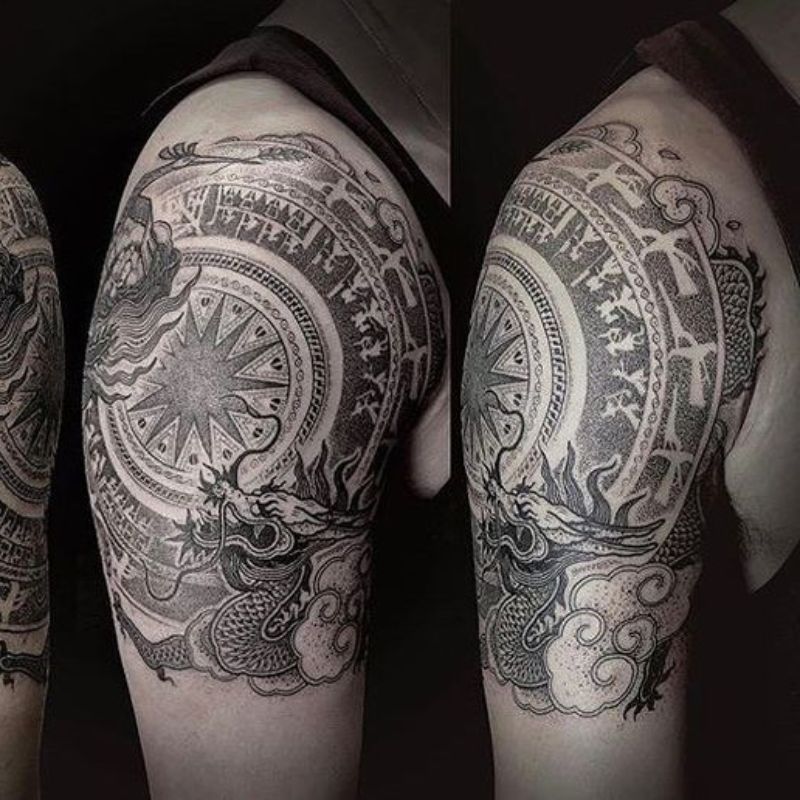
Sacred Vietnamese architecture tattoos are commonly expressed through neo-traditional, fine line, blackwork, and realism styles. Each approach highlights different aspects of architectural detail, from structural precision to atmospheric storytelling. The choice of style significantly affects how cultural symbolism and visual depth are communicated on the skin.
Information Gain Insight: Experienced tattoo artists often combine multiple styles within a single piece to reflect architectural complexity. For example, fine line detailing may be used for structural outlines, while blackwork shading adds depth to temple roofs and background landscapes, creating a layered architectural illusion.
Minimalist vs Detailed Architectural Tattoo Approaches
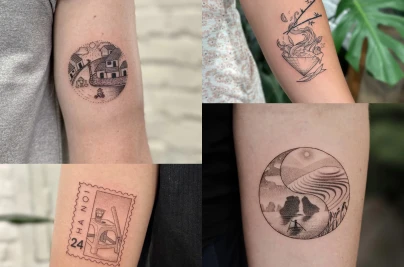
Minimalist sacred Vietnamese architecture tattoos focus on simplified structural outlines, emphasizing silhouette and spatial balance. In contrast, detailed approaches replicate carvings, roof textures, and environmental context. Both styles serve different purposes depending on personal meaning and placement strategy.
Minimalist designs are often chosen for wrist, forearm, or ankle placements, where clarity over distance is essential. Detailed compositions are more suitable for full sleeves or back pieces, where architectural storytelling can unfold across larger anatomical surfaces.
Sleeve Composition Strategy Using Architecture Flow
Architectural sleeve tattoos require careful composition planning to maintain visual flow and structural coherence. Sacred Vietnamese designs often follow a vertical narrative structure, starting from grounding elements at the wrist or shoulder and expanding toward spiritual elevation at the upper arm or back.
Expert Insight: Skilled tattoo designers treat the body like a “living architectural canvas,” aligning temple roofs with muscle curvature and positioning gates at natural transition points such as elbows or shoulders to enhance movement realism and symbolic storytelling.
Lucky Tattoo, a professional tattoo artist, has over 10 years of experience in the art of tattooing in Ho Chi Minh City. Lucky Tattoo Studio was founded in 2014 by skilled and kind artists. All tattoos are provided in a clean, strictly controlled, and friendly environment.
Best Placement Ideas for Architectural Tattoos
Sacred Vietnamese architecture tattoos are best placed on areas of the body that allow structural flow, symmetry, and vertical storytelling such as the arm, back, and chest. Placement determines how architectural elements align with anatomy, ensuring temples, gates, and roofs maintain proportion, movement, and visual balance across the body.
Information Gain Insight: One commonly overlooked factor is how muscle movement affects architectural distortion. Skilled tattoo artists map designs based on flex points such as elbows and shoulders, ensuring that temple structures do not “break” visually when the body moves.
Full Sleeve Design Inspired by Pagodas
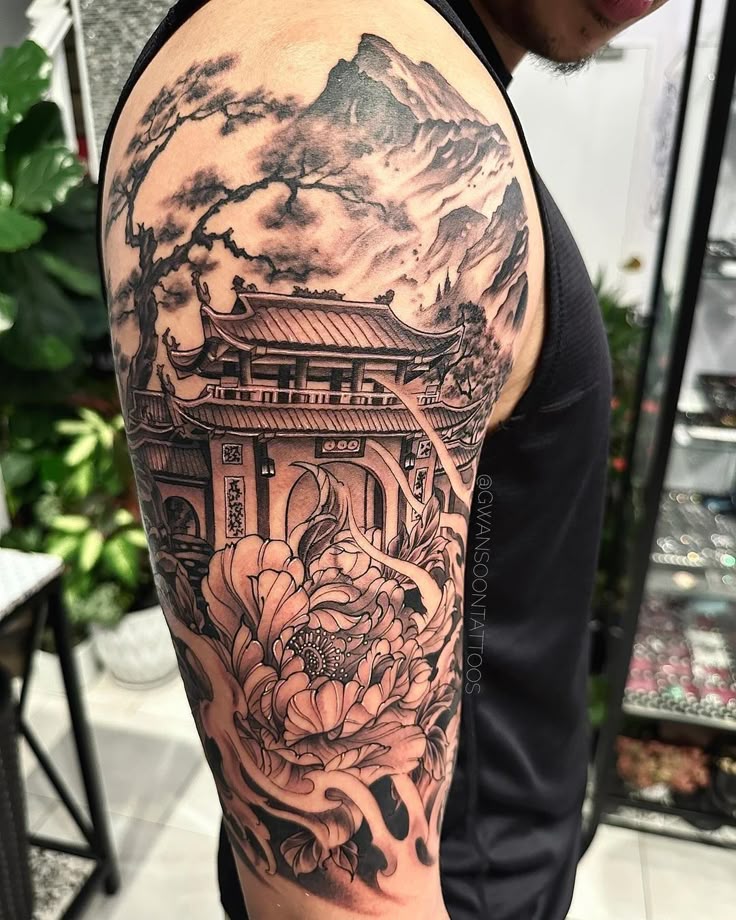
A full sleeve tattoo inspired by Vietnamese pagodas functions like a continuous architectural narrative wrapping around the arm. It typically begins with grounding elements such as stone bases or gates and progresses upward into temple roofs and spiritual symbols representing enlightenment or ancestral connection.
In designs influenced by Huế Imperial City or traditional pagodas, artists often incorporate layered rooftops that follow the natural curvature of the bicep and forearm. This enhances realism and creates the illusion that the architecture exists in three-dimensional space.
Pain, Healing, and Longevity Considerations
Architectural tattoos with high detail density require longer sessions and multiple healing phases. Areas with thin skin such as ribs, inner arms, and collarbones tend to be more painful and may impact line consistency if proper aftercare is not followed. Healing quality directly affects how architectural precision is preserved over time.
Evidence-Based Recommendation: Dermatological studies on tattoo healing show that excessive sun exposure during the first 30 days significantly reduces ink retention quality. For architectural tattoos, this can blur fine structural lines, reducing clarity of temple roofs and ornamental carvings.
Common Mistake: Many clients underestimate long-term aging effects on fine-line temple details. Without proper shading contrast and spacing, architectural tattoos may lose definition within 5–8 years, especially in high-friction body areas.
Cultural Respect and Appropriation Concerns
Sacred Vietnamese architecture tattoos require cultural awareness because they are rooted in religious, historical, and ancestral significance. Ethical tattooing involves understanding symbolism, respecting sacred structures, and avoiding superficial or distorted representations that may misinterpret Vietnamese heritage or spiritual traditions.
Information Gain Insight: Unlike generic architectural tattoos, Vietnamese sacred structures often carry living cultural significance. This means certain designs are still actively used in worship contexts, making accurate representation and respectful adaptation essential to avoid cultural misrepresentation.
How to Choose a Culturally Authentic Tattoo Artist
Choosing the right tattoo artist is critical for authenticity. Ideal artists often have experience in Southeast Asian motifs, architectural illustration, or cultural storytelling tattoos. They should demonstrate an understanding of structural proportion, symbolic meaning, and historical context rather than relying solely on reference images.
Clients should review portfolios for evidence of architectural accuracy, such as correctly proportioned roofs, aligned symmetry, and consistent perspective lines. Artists who have traveled or studied Vietnamese heritage sites often produce more informed and respectful interpretations.
What Makes a Design Culturally Accurate
A culturally accurate Vietnamese architectural tattoo maintains structural integrity, symbolic correctness, and contextual respect. This includes correct representation of pagoda tiers, gate orientations, and decorative motifs such as dragons or lotus elements, which carry specific meanings in Vietnamese spiritual culture.
- Structural accuracy: Proper roof angles and symmetry
- Symbolic integrity: Correct use of Buddhist and ancestral motifs
- Contextual respect: Avoiding mixing unrelated cultural symbols
- Proportional realism: Architectural consistency with real monuments
Expert Observation: Many low-quality designs fail because they blend Vietnamese architecture with unrelated East Asian styles, creating cultural confusion. Authentic tattoos maintain regional specificity tied to actual Vietnamese heritage sites.
Real Vietnamese Architecture Inspirations for Tattoos
Sacred Vietnamese architecture tattoos are often inspired by real heritage sites such as pagodas, imperial cities, and historical temples. These landmarks provide structural templates, symbolic meaning, and compositional references that help tattoo artists create accurate and culturally grounded designs.
Information Gain Insight: The most impactful architectural tattoos are not copied directly from photos but reconstructed from multiple reference angles. Artists combine ground-level, aerial, and historical imagery to create a composite architectural interpretation suited for body mapping.
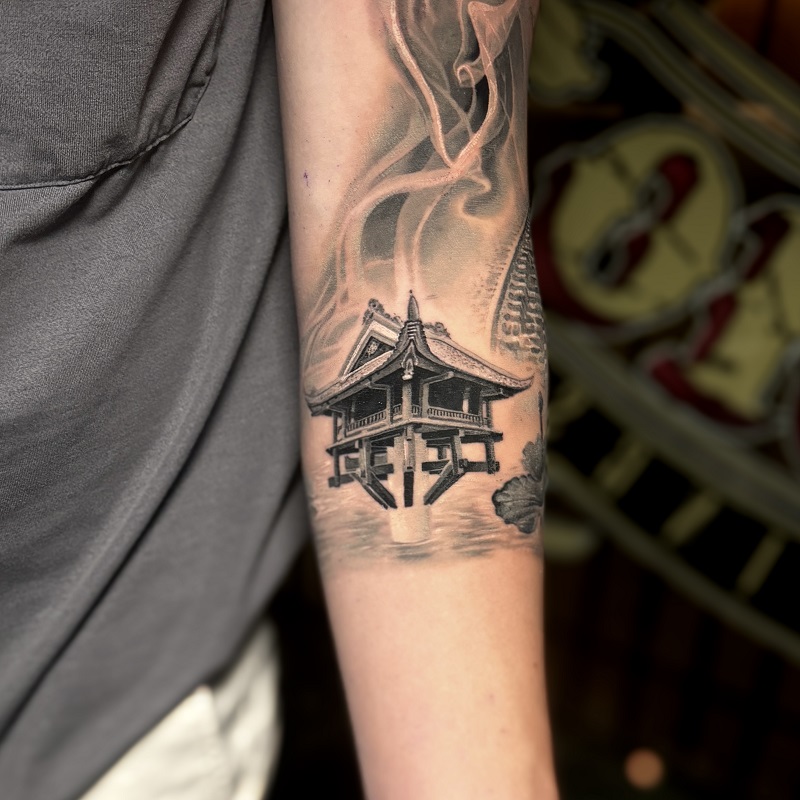
One Pillar Pagoda Tattoo Interpretation
The One Pillar Pagoda is one of Vietnam’s most iconic spiritual structures and is frequently adapted into minimalist architectural tattoos. Its lotus-inspired design symbolizes purity and enlightenment, making it ideal for small to medium placements such as forearms or calves.
In tattoo interpretation, artists often emphasize the central pillar as a grounding axis of stability while simplifying surrounding details to maintain clarity over time. This ensures the symbolic meaning remains intact even as the tattoo ages.
Thien Mu Pagoda Tattoo Symbolism
The Thien Mu Pagoda represents longevity, spirituality, and harmony with nature. As a tattoo design, it is often used for larger compositions due to its vertical tower structure and surrounding landscape elements that allow for storytelling expansion across the body.
Artists frequently integrate river landscapes and mist effects to enhance atmosphere, reflecting the real-world setting of the pagoda near the Perfume River. This adds emotional depth and spatial realism to the tattoo composition.
Expert Tattoo Design Process (Step-by-Step)
Sacred Vietnamese architecture tattoos follow a structured design process involving cultural research, architectural analysis, sketch development, and anatomical mapping. Each step ensures that the final tattoo is both visually accurate and culturally respectful while maintaining long-term aesthetic integrity on the skin.
Information Gain Insight: The most successful architectural tattoos begin with “spatial translation planning,” where artists determine how 3D structures will wrap around 2D body surfaces before any drawing begins.
- Cultural research: Study of Vietnamese heritage sites and symbolism
- Architectural breakdown: Deconstruction of structural elements
- Composition mapping: Aligning design with body anatomy
- Sketch development: Creating layered architectural drafts
- Final execution: Inking with attention to flow and detail balance
Frequently Asked Questions (FAQs)
What does a sacred Vietnamese architecture tattoo symbolize?
It symbolizes spirituality, ancestry, protection, and cultural identity, often inspired by temples and pagodas that represent harmony between the physical and spiritual worlds.
Are Vietnamese architecture tattoos religious?
They can be spiritual but are not strictly religious. They often reflect cultural heritage, Buddhist influence, and ancestral respect rather than formal religious practice.
Which Vietnamese structures are most popular for tattoos?
Common inspirations include Huế Imperial City, One Pillar Pagoda, Thien Mu Pagoda, and the Temple of Literature due to their strong symbolic and architectural value.
Do architectural tattoos age well?
Yes, if designed with proper spacing, shading contrast, and structural balance. Overly detailed fine-line designs may blur faster without expert execution.
How do artists convert temples into tattoo designs?
They break down architectural elements such as roofs, gates, and symmetry, then reconstruct them into compositions that fit the natural flow of the body.
Is it culturally appropriate to get a Vietnamese temple tattoo?
Yes, if done respectfully with accurate symbolism and understanding of cultural context. Working with knowledgeable artists ensures authenticity and avoids misrepresentation.
What is the best placement for temple tattoos?
Arm sleeves, back pieces, and chest designs are ideal because they allow architectural flow, symmetry, and vertical storytelling across the body.
Conclusion: The Living Architecture of Tattoo Art
Sacred Vietnamese architecture tattoos represent more than visual design—they are living interpretations of cultural memory, spiritual philosophy, and architectural heritage. When executed with precision and respect, they become timeless body art that bridges history, identity, and personal storytelling through the language of sacred structures.