What Is a Detailed Forearm Sleeve Tattoo?
A detailed forearm sleeve tattoo is a fully or partially connected composition of tattoos designed to flow from wrist to elbow using a unified theme, shading system, and visual hierarchy. Unlike standalone tattoos, it is planned as a single artwork system that interacts with arm anatomy, movement, and long-term skin aging.
In professional tattooing, a forearm sleeve is not simply “multiple tattoos placed together.” It is a structured visual narrative built over multiple sessions, often requiring pre-planned composition mapping to ensure continuity across different artists, time gaps, and evolving ideas.
Forearm Sleeve vs Patchwork Tattoos (Critical Structural Difference)
A forearm sleeve tattoo is a deliberately unified composition where each element connects through flow, shading, and theme consistency, whereas patchwork tattoos are independent pieces placed without strict continuity. The difference is structural: sleeves are designed systems, while patchwork is accumulation without narrative planning.
Expert tattoo artists often observe that poorly planned sleeves age visually into “fragmented surfaces,” while structured sleeves maintain clarity even after 10–15 years due to intentional spacing and flow control.
Why Cohesion Matters More Than Individual Tattoo Quality
Cohesion determines whether a sleeve reads as a professional artwork or a disconnected collection. Even high-quality individual tattoos can lose impact when spacing, shading direction, and thematic consistency are ignored. Cohesion creates visual hierarchy, allowing the eye to travel naturally across the forearm.
Information Gain Insight: Many clients focus on tattoo detail quality but overlook “transition design.” In professional sleeve construction, transitions between tattoos often require more skill than the tattoos themselves because they define readability over time.
Forearm Sleeve Tattoo Design Principles (Anatomy, Flow & Composition)
A forearm sleeve tattoo is built using design principles similar to architecture and visual storytelling, where anatomy, movement, and composition guide placement decisions. Professional artists map tattoos along muscle direction, ensuring that imagery flows naturally with wrist rotation and elbow flexion for long-term visual harmony.
Successful sleeve design depends on balancing focal points, negative space, and directional flow so the artwork remains readable from multiple angles. Without these principles, sleeves can appear overcrowded or visually chaotic when the arm is in motion.
How Forearm Anatomy Shapes Tattoo Flow
Forearm anatomy directly influences tattoo placement because muscle curvature determines how ink appears when the arm rotates. The outer forearm offers smoother surfaces for detailed imagery, while inner forearm areas are more sensitive and often used for lighter shading or symbolic elements.
Artists strategically align long visual elements—such as waves, smoke, or geometric lines—with muscle direction to create a natural “movement illusion.” This ensures the tattoo feels alive rather than static when the arm moves.
Information Gain Insight: Many beginners underestimate how much arm rotation affects tattoo perception. A design that looks balanced in a flat stencil may distort significantly when the wrist twists, which is why experienced artists always test flow in motion before tattooing.
Visual Hierarchy: Focal Points vs Background Structure
Visual hierarchy in forearm sleeve tattoos determines what the viewer notices first and how attention moves across the design. Strong sleeves use dominant focal points—such as portraits, mythological figures, or bold geometric cores—supported by secondary shading and background textures.
Without hierarchy, tattoos compete for attention and lose narrative clarity. Skilled artists use contrast, saturation, and spacing to guide the viewer’s eye in a controlled path from wrist to elbow or vice versa.
Common Mistake: Many clients request multiple “main elements” in one sleeve, resulting in visual conflict. Professional sleeve planning limits focal dominance to 1–3 anchor points per forearm section.
Best Styles for Detailed Forearm Sleeve Tattoos
Detailed forearm sleeve tattoos are most successful when style selection aligns with both skin behavior and long-term visual clarity. Styles such as black and grey realism, Japanese irezumi, and geometric compositions perform differently in aging, shading retention, and readability over time, making style choice a technical decision—not just aesthetic preference.
Experienced tattoo artists often recommend selecting a primary style before adding thematic elements because mixing incompatible styles can weaken cohesion and accelerate visual degradation as ink fades or blurs.
Black and Grey Realism Sleeves (Depth, Longevity, Control)
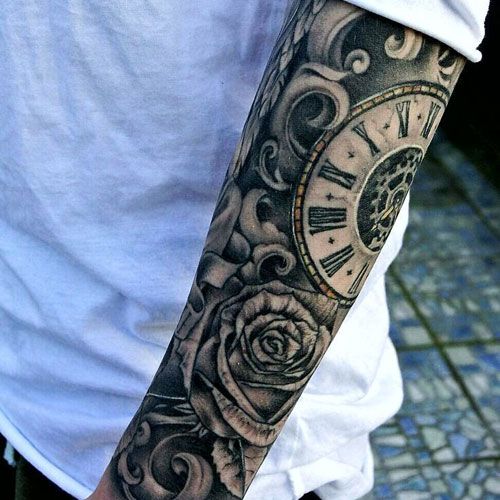
Black and grey realism sleeves use gradients of diluted black ink to create depth, shadow, and lifelike detail. This style is widely preferred for forearm sleeves because it ages more gracefully than color-heavy designs, maintaining contrast even after years of skin exposure and natural fading.
Realism sleeves often include portraits, wildlife, or cinematic imagery, with heavy emphasis on shading transitions rather than hard outlines. The forearm’s curvature enhances depth perception, making realistic shading appear more dimensional.
Expert Insight: Realism sleeves require highly controlled saturation levels. Overpacked ink reduces skin flexibility over time, leading to unnecessary distortion in detailed areas such as eyes, facial features, or fine textures.
Japanese Irezumi Forearm Sleeves (Flow, Symbolism & Movement)
Japanese irezumi sleeves are structured around flowing compositions inspired by water, wind, mythology, and nature. These designs are specifically engineered for body movement, making them highly effective for forearm placement where rotation enhances visual storytelling.
Common elements include koi fish, dragons, waves, and cherry blossoms, each carrying symbolic meaning tied to strength, resilience, or impermanence. These elements are arranged using strict compositional rules that prioritize flow over isolation of individual imagery.
Information Gain Insight: Unlike Western tattoo styles that often emphasize isolated realism, Japanese sleeves prioritize “continuous motion logic,” meaning every element is designed to visually push the eye forward along the limb.
Geometric and Sacred Pattern Sleeves (Structure & Precision)
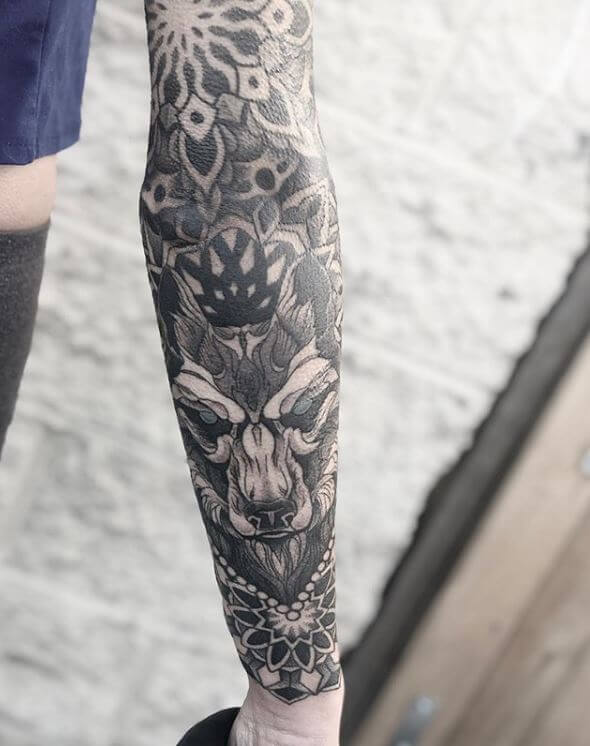
Geometric forearm sleeves rely on symmetry, repetition, and mathematical precision to create visually structured designs. Mandalas, sacred geometry, and line-based frameworks are commonly used to build rhythm and balance across the forearm surface.
This style is especially effective for individuals seeking clean, modern aesthetics with strong visual order. Unlike realism or illustrative tattoos, geometric sleeves depend heavily on alignment accuracy, where even minor spacing errors can disrupt symmetry.
Common Misconception: Many assume geometric tattoos are simpler to execute, but they often require more technical precision than realism due to the need for perfect proportional consistency across curved skin surfaces.
Lucky Tattoo, a professional tattoo artist, has over 10 years of experience in the art of tattooing in Ho Chi Minh City. Lucky Tattoo Studio was founded in 2014 by skilled and kind artists. All tattoos are provided in a clean, strictly controlled, and friendly environment.
Forearm Sleeve Tattoo Ideas by Theme (Concept Architecture & Meaning)
A detailed forearm sleeve tattoo by theme is a structured concept system where imagery, symbolism, and visual flow are unified around a central narrative such as nature, mythology, or personal identity. This approach ensures coherence, improves long-term readability, and allows artists to build progressive storytelling across multiple sessions.
The most successful sleeves are not random collections of images but intentional thematic ecosystems. Each element is selected for symbolic relevance and visual compatibility, ensuring the design remains cohesive even as it evolves over time or expands into a full sleeve.
Nature-Themed Forearm Sleeves (Organic Flow & Balance)
A nature-themed forearm sleeve tattoo uses organic elements such as forests, animals, mountains, and water to create natural movement across the arm. These designs are highly effective because they mirror the body’s natural curves, allowing smooth transitions between focal points and background shading.
Forearm placement enhances nature themes due to its elongated structure, which naturally supports river flows, tree growth direction, and animal movement dynamics. Artists often build these sleeves in layers to mimic depth found in natural environments.
Information Gain Insight: One overlooked design principle is “ecological layering,” where foreground animals, midground foliage, and background shading are structured like real ecosystems, dramatically improving realism and depth perception over time.
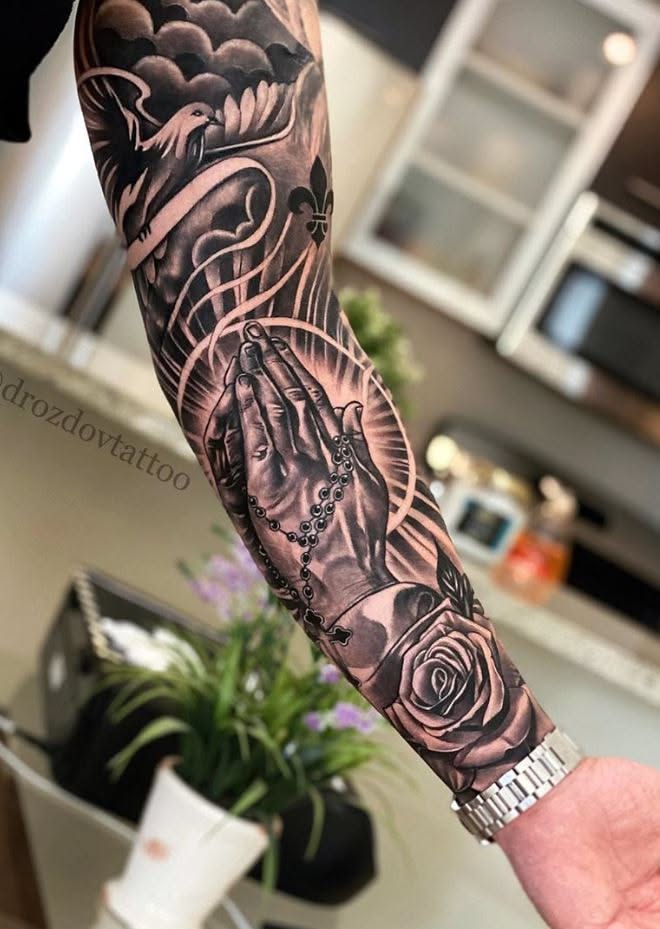
Mythological & Symbolic Forearm Sleeves (Story-Driven Design)
Mythological forearm sleeves are built around narrative storytelling using gods, legends, spiritual symbols, and archetypal imagery. These tattoos often combine multiple cultural references into a unified composition that reflects personal identity, resilience, or transformation.
Unlike purely aesthetic designs, mythological sleeves require narrative sequencing, where each visual element represents a stage of symbolic meaning. This creates a “reading path” across the arm, enhancing emotional depth and interpretability.
Common Mistake: Many clients overcrowd mythological sleeves with unrelated symbols, weakening narrative clarity. Expert artists recommend limiting each sleeve to one dominant mythological framework for maximum coherence.
Pain Level, Healing & Skin Behavior (Medical & Practical Reality)
A forearm sleeve tattoo involves moderate pain levels with variation depending on proximity to bone, nerve density, and skin thickness. Healing typically occurs in stages over 2–4 weeks per session, requiring strict aftercare to prevent ink loss, infection, or uneven healing that can compromise sleeve consistency.
Understanding skin behavior is essential because tattoos are permanent modifications to living tissue. Factors such as hydration, UV exposure, and immune response significantly affect how ink settles and ages over time.
Pain Distribution Across the Forearm (What to Expect)
Pain levels in forearm tattoos vary significantly between outer and inner regions. The outer forearm is generally more tolerable due to thicker skin and fewer nerve endings, while the inner forearm near the wrist can be more sensitive and prone to sharper sensations during shading or linework.
Experienced tattoo clients often describe forearm pain as manageable compared to ribs or spine, but cumulative fatigue increases during long sleeve sessions lasting multiple hours.
Information Gain Insight: Pain perception is not constant during a session. As adrenaline decreases, sensitivity increases, which is why professional artists schedule shading and detail work strategically within session timing.
Healing Stages & Dermatological Considerations
Forearm tattoo healing occurs in predictable biological stages: inflammation, scabbing, and remodeling. Each stage affects ink retention differently, making aftercare consistency critical for long-term visual quality and color stability.
Improper healing can lead to patchy fading, blurred linework, or uneven saturation. Dermatology research highlights the importance of moisture balance and UV protection during the early healing window.
Citation Opportunity: :contentReference[oaicite:0]{index=0} recommends avoiding direct sun exposure and soaking during early tattoo healing stages to reduce infection and pigment disruption risks.
Common Aftercare Mistakes That Damage Sleeve Quality
Many forearm sleeve issues arise not during tattooing but during healing. Common mistakes include over-moisturizing, premature sun exposure, and picking scabs, all of which interfere with pigment retention and skin regeneration.
- Overwashing the tattoo area disrupts natural healing barriers
- Using petroleum-heavy products too early can trap bacteria
- Ignoring SPF protection accelerates fading over time
Information Gain Insight: One overlooked factor is “micro-movement healing distortion,” where excessive physical strain during healing (gym, manual work) subtly affects ink settling patterns in high-flex zones like the wrist.
Cost of a Detailed Forearm Sleeve Tattoo (Value vs Investment)
A detailed forearm sleeve tattoo typically varies in cost based on artist expertise, design complexity, and geographic location. Pricing reflects not only time spent tattooing but also design development, stencil planning, and multi-session execution required to maintain cohesive visual structure.
High-quality sleeves should be viewed as long-term artistic investments rather than one-time purchases, as experienced artists prioritize durability, aging performance, and compositional integrity.
Why Artist Experience Drastically Impacts Price
Experienced tattoo artists charge higher rates because they bring technical precision, design foresight, and advanced skin knowledge that directly impacts how well a sleeve ages. Their ability to anticipate flow, contrast loss, and pigment diffusion reduces long-term distortion risks.
In contrast, lower-cost tattoos often lack structural planning, resulting in sleeves that require correction or fading compensation later.
Information Gain Insight: Professional sleeve artists often design “future-proofing layers,” anticipating how ink will soften over 10–15 years and adjusting contrast accordingly at the initial stage.
Budget vs Premium Sleeve Outcomes
Budget sleeves often prioritize speed and surface-level aesthetics, while premium sleeves emphasize structural design, layering logic, and long-term skin behavior. The difference becomes more visible after 2–3 years when fading and distortion begin to appear.
| Factor | Budget Sleeve | Premium Sleeve |
|---|---|---|
| Design planning | Minimal | Extensive multi-session mapping |
| Aging performance | Uneven fading | Controlled contrast retention |
| Composition | Fragmented | Fully cohesive narrative |
How Artists Plan a Cohesive Forearm Sleeve (Professional Workflow)
A cohesive forearm sleeve tattoo is planned using structured design workflows that integrate sketch development, anatomical mapping, and phased execution over multiple sessions. Professional tattoo artists treat sleeves as evolving compositions rather than single-session artworks, ensuring visual continuity and long-term balance.
This process typically begins with concept refinement, followed by layout planning that defines focal points, transitions, and background flow before any ink is applied to skin.
Concept Development & Theme Locking
Concept development involves selecting a central theme and locking it before execution begins. This ensures all subsequent elements contribute to a unified narrative rather than disconnected visual ideas added over time.
Artists often use reference boards, rough sketches, and compositional overlays to visualize how different elements interact across the forearm’s curved surface.
Information Gain Insight: Experienced artists avoid “open-ended sleeves” because lack of theme locking leads to inconsistency, requiring expensive redesign or cover-up work later.
Layering Strategy: Background, Midground & Foreground
Layering is the structural backbone of sleeve design, separating visual elements into depth tiers. Background shading creates atmosphere, midground elements build structure, and foreground imagery establishes focal dominance.
This technique prevents visual flattening and ensures tattoos remain readable from different distances and angles.
Session-Based Execution Planning
Sleeves are completed in stages to allow skin recovery and design adjustments. Each session builds upon the previous one, gradually increasing complexity while preserving structural integrity.
Common Mistake: Rushing sleeve completion often results in uneven saturation and misaligned transitions that are difficult to correct without laser removal or cover-up work.
FAQ: Detailed Forearm Sleeve Tattoo (Expert Answers)
How long does a forearm sleeve tattoo take to complete?
A detailed forearm sleeve typically takes 2–6 sessions depending on complexity, healing time, and artist scheduling, often spanning several weeks or months for full completion.
Does a forearm sleeve tattoo hurt a lot?
Pain is moderate overall, with higher sensitivity near the wrist and inner forearm due to thinner skin and nerve concentration.
What tattoo style lasts longest on the forearm?
Black and grey realism and bold linework styles generally age better because they maintain contrast even as ink naturally softens over time.
Can I mix styles in one sleeve?
Yes, but it requires expert composition planning to avoid visual conflict. Incompatible styles can reduce cohesion and long-term readability.
How do forearm tattoos age over time?
Forearm tattoos gradually soften due to UV exposure, skin regeneration, and ink dispersion, but proper aftercare significantly slows fading.
Is a forearm sleeve tattoo suitable for professional environments?
Visibility depends on workplace policy, but many professionals choose forearm placement because it can be easily covered with long sleeves if needed.
Conclusion: Building a Forearm Sleeve That Lasts
A detailed forearm sleeve tattoo is a long-term artistic system that combines anatomy-aware design, structured storytelling, and technical precision. When properly planned, it evolves with the body rather than degrading over time, maintaining clarity, symbolism, and visual impact for decades.
The difference between a good sleeve and a great one lies not in individual tattoo quality, but in how effectively every element works together as a unified visual architecture across the forearm.
Lucky Tattoo, a professional tattoo artist, has over 10 years of experience in the art of tattooing in Ho Chi Minh City. Lucky Tattoo Studio was founded in 2014 by skilled and kind artists. All tattoos are provided in a clean, strictly controlled, and friendly environment.
detailed-forearm-sleeve