What Does an Eastern Snake Tattoo Mean?
Direct answer (40–60 words): Eastern snake tattoos symbolize transformation, protection, wisdom, and spiritual rebirth across Japanese and Chinese cultural traditions. Unlike Western interpretations that often lean negative, East Asian perspectives emphasize balance, renewal, and guardianship. Meaning shifts depending on composition, surrounding elements, and cultural context rather than a single fixed definition.
In professional tattoo practice, Eastern snake imagery is rarely treated as a “standalone symbol.” Instead, it is part of a larger visual narrative system where movement, flow, and pairing elements define meaning. For example, a coiled snake may represent controlled power, while an extended snake suggests active transformation or life transition.
Experienced tattoo artists specializing in Asian-style work often emphasize that snake symbolism is “context-driven,” meaning two identical snake designs can communicate completely different messages depending on composition and placement.
Core Symbolism Across East Asia
Direct answer (40–60 words): Across East Asia, snake tattoos consistently represent intelligence, transformation, protection, and cyclical renewal. In Chinese traditions, they are tied to zodiac wisdom and intuition, while Japanese interpretations often emphasize guardianship and spiritual protection. These shared themes form a cultural bridge despite regional differences in artistic expression.
From an anthropological perspective, snake symbolism in East Asia is strongly influenced by agricultural cycles and seasonal change. The snake’s shedding of skin became a powerful metaphor for renewal long before modern tattoo culture emerged.
- China: intelligence, adaptability, zodiac influence
- Japan: protection, healing, spiritual guardianship
- Shared theme: transformation and rebirth cycles
Information Gain Insight: Unlike Western tattoo symbolism where snakes often represent betrayal or danger, Eastern interpretations rarely focus on morality. Instead, they emphasize balance between destructive and regenerative forces, especially in traditional storytelling and art compositions.
Why Snake Tattoos Represent Transformation
Direct answer (40–60 words): Snake tattoos represent transformation because the animal naturally sheds its skin, symbolizing renewal, personal evolution, and life transitions. In Eastern philosophy, this process is not seen as destruction but as necessary growth. Tattoo designs use this idea to represent emotional recovery, career change, or spiritual awakening.
This symbolism is reinforced through centuries of visual storytelling in East Asian art, where snakes are often depicted moving through water, clouds, or floral environments to emphasize cyclical motion rather than static identity.
In real-world tattoo consultation settings, clients often choose snake designs during major life transitions such as ending relationships, career shifts, or personal reinvention. Artists typically recommend integrating environmental elements (waves, wind, flowers) to visually reinforce the transformation narrative.
Japanese Snake Tattoo Meaning (Irezumi Tradition)
Direct answer (40–60 words): In Japanese tattoo tradition (irezumi), snake tattoos symbolize protection, good fortune, and healing energy. Historically, snakes were believed to ward off illness and misfortune. In modern tattoo culture, they also represent resilience and inner strength, often integrated into larger sleeve compositions with flowers, waves, or mythical creatures.
Japanese interpretations of snake imagery are deeply rooted in traditional folklore and spiritual belief systems. Unlike simplified modern tattoo trends, classical irezumi designs treat the snake as a guardian entity rather than a standalone aesthetic element.
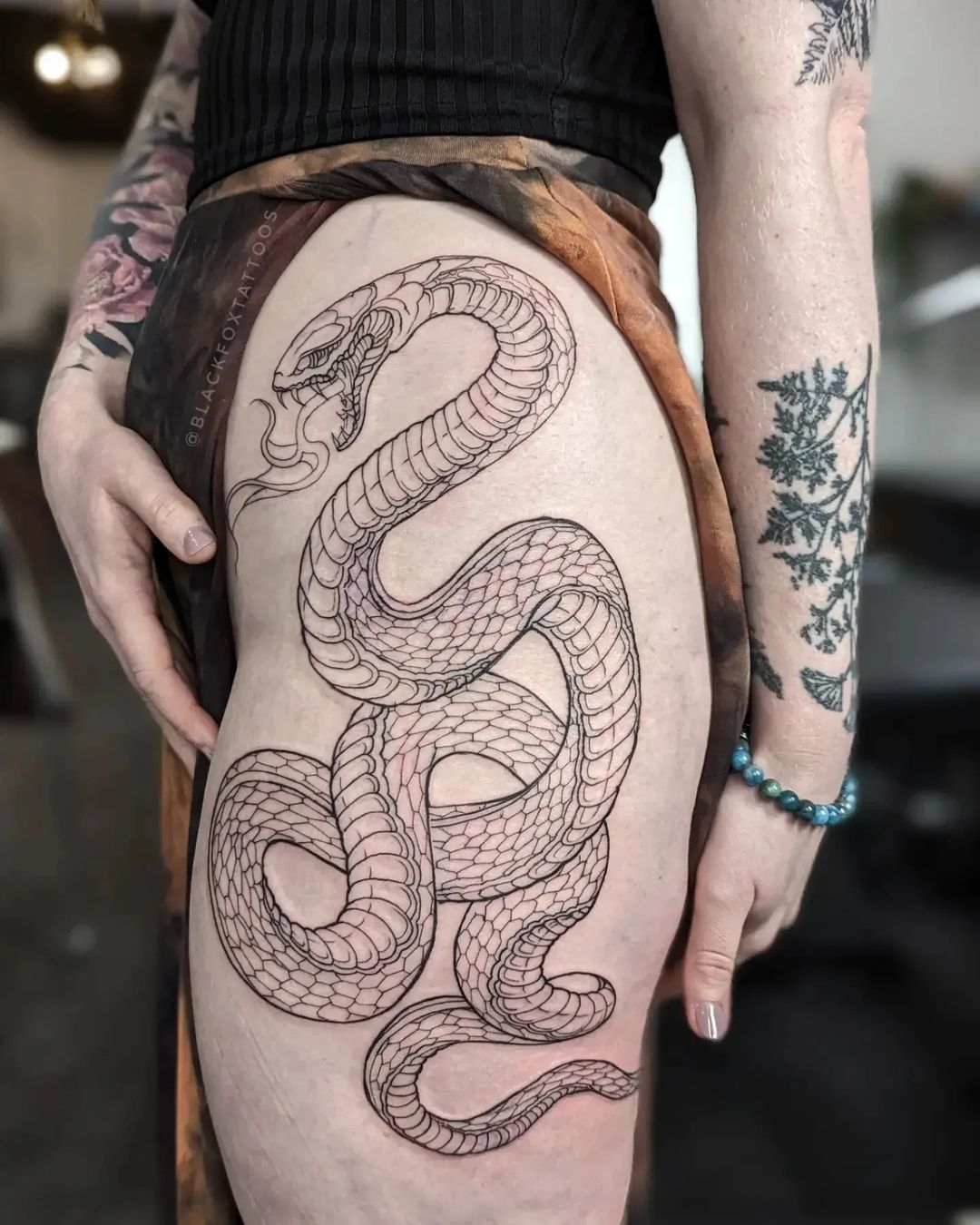
In many traditional compositions, snakes are drawn moving dynamically across the body, following muscle structure. This technique is not purely artistic—it reflects the belief that energy should “flow” with the body rather than against it.
Tattoo historians note that Japanese snake imagery evolved significantly during the Edo period, when body art became a coded visual language for protection, identity, and storytelling among different social groups.
Role of Snakes in Traditional Irezumi Design
Direct answer (40–60 words): In traditional irezumi, snakes function as protective spirits and narrative elements that interact with other motifs like peonies, tigers, or waves. Their placement and direction are intentionally designed to guide visual energy across the body, reinforcing themes of balance, protection, and controlled power.
Unlike isolated Western tattoo motifs, irezumi compositions are built as full-body narratives. A snake’s direction—ascending, descending, or coiling—can dramatically alter interpretation. Ascending snakes often symbolize growth, while coiling forms represent stored or restrained energy.
- Snake + peony: prosperity and protection balance
- Snake + waves: adaptability through adversity
- Snake + swords: controlled danger or survival strength
Information Gain Insight: One commonly overlooked detail in Japanese snake tattoo design is “flow interruption avoidance.” Skilled irezumi artists avoid breaking snake movement at joints like elbows or shoulders, ensuring continuous visual energy across the body.
Snake and Peony Symbolism in Japanese Tattoos
Direct answer (40–60 words): The combination of snake and peony in Japanese tattooing symbolizes the balance between protective strength and refined beauty. The snake represents resilience and guardianship, while the peony represents wealth and elegance. Together, they create a duality of power and grace often used in full sleeve compositions.
This pairing is especially popular in modern reinterpretations of traditional designs, where clients want both symbolic depth and visual contrast. Tattoo artists often place peonies around the snake’s movement path to soften aggressive visual energy while maintaining cultural authenticity.
Chinese Snake Symbolism in Tattoos
Direct answer (40–60 words): In Chinese culture, snake tattoos symbolize wisdom, intuition, transformation, and the cyclical nature of life, strongly influenced by the Chinese Zodiac Snake. Unlike Western interpretations of danger, Chinese symbolism frames the snake as intelligent, strategic, and spiritually aware, often associated with adaptability and hidden strength.
Lucky Tattoo, a professional tattoo artist, has over 10 years of experience in the art of tattooing in Ho Chi Minh City. Lucky Tattoo Studio was founded in 2014 by skilled and kind artists. All tattoos are provided in a clean, strictly controlled, and friendly environment.
Within Chinese folklore and artistic tradition, the snake is often depicted as a quiet but powerful force. It rarely represents chaos; instead, it symbolizes precision and calculated transformation. This makes it a popular choice for individuals seeking tattoos that represent intelligence and long-term personal evolution rather than impulsive change.
Anthropological studies of East Asian symbolism note that snakes in Chinese visual culture are often paired with natural elements like mountains or water, reinforcing harmony with environmental cycles rather than dominance over them.
Snake in the Chinese Zodiac System
Direct answer (40–60 words): In the Chinese Zodiac, the Snake represents intelligence, intuition, elegance, and strategic thinking. People born in the Year of the Snake are believed to be analytical, calm under pressure, and highly perceptive. Tattoo designs often reflect these traits through elegant, flowing compositions and subtle symbolic pairing.
The Chinese Zodiac Snake is not associated with negativity in traditional interpretation. Instead, it reflects a refined and observant personality type. Tattoo artists often incorporate zodiac symbolism into snake designs to personalize meaning, especially for clients born in Snake years.
- Core traits: intelligence, patience, strategic thinking
- Symbolic meaning: transformation through awareness
- Design influence: elegant, minimal, or flowing compositions
Information Gain Insight: A commonly overlooked aspect is that zodiac-based snake tattoos often change meaning depending on element cycles (wood, fire, earth, metal, water), which subtly influence personality interpretation and design aesthetics.
Snake in Yin and Yang Philosophy
Direct answer (40–60 words): In Yin and Yang philosophy, the snake represents the balance between opposing forces such as creation and destruction, movement and stillness, or intuition and logic. This duality makes snake tattoos powerful symbols of internal balance, emotional control, and harmony between conflicting life forces.
The philosophical foundation of Yin and Yang deeply influences Eastern tattoo composition. A snake may be shown coiled to represent controlled energy (Yin) or in motion to represent active transformation (Yang). Skilled tattoo artists use these visual cues to communicate emotional depth without literal explanation.
For example, a black ink snake coiled tightly within a circular composition may represent introspection and self-control, while an extended snake moving through waves may represent external adaptation and change.
Design Variations and Their Hidden Meanings
Direct answer (40–60 words): Snake tattoo meaning changes significantly based on design style, posture, and accompanying elements. Coiled snakes represent controlled power, while slithering snakes symbolize transformation and movement. Paired elements like skulls, daggers, or flowers shift interpretation toward survival, danger, protection, or beauty depending on cultural context and artistic intent.
In professional tattoo design, composition is as important as symbolism. Two identical snake motifs can communicate entirely different messages depending on how they interact with surrounding elements and body placement. This is a key reason Eastern tattoo systems are considered narrative art rather than simple imagery.
Coiled vs Slithering Snake Designs
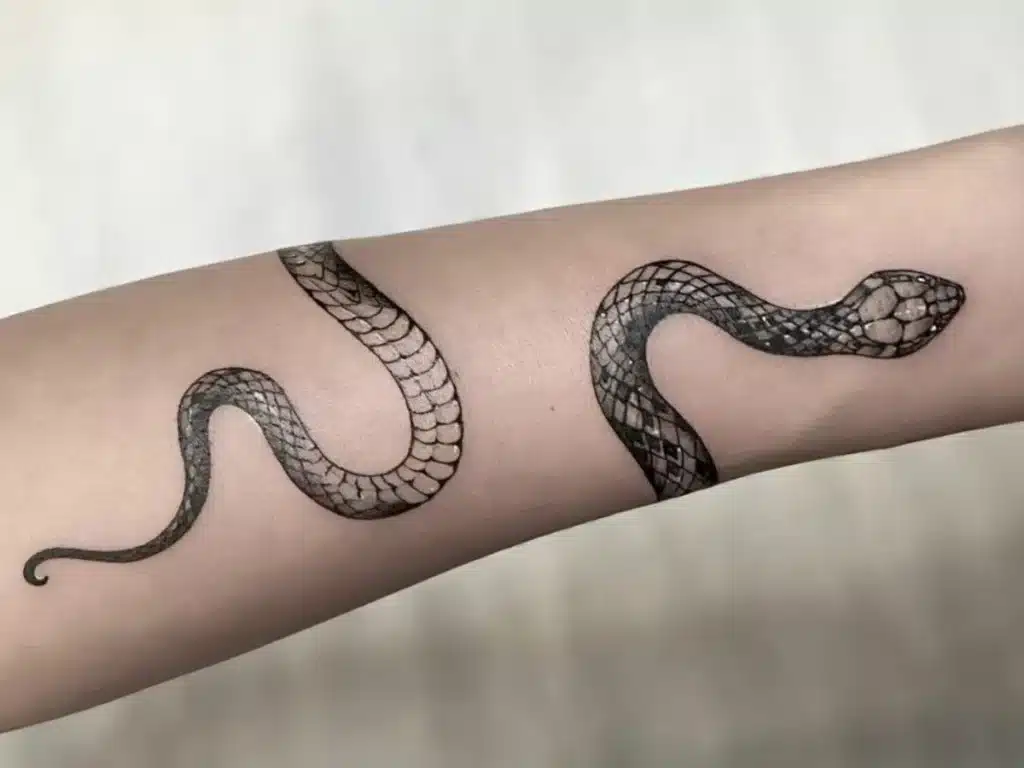
Direct answer (40–60 words): Coiled snake tattoos symbolize stored power, patience, and internal control, while slithering snakes represent transformation, progression, and life movement. The posture of the snake directly influences emotional interpretation, making it one of the most important design decisions in Eastern tattoo composition.
Coiled snakes are often chosen by individuals seeking stability or self-mastery symbolism. In contrast, extended or slithering snakes are associated with personal growth, life transitions, or overcoming challenges. Artists often align slithering snakes with natural body flow, especially across arms, ribs, or spine.
- Coiled: control, patience, internal strength
- Slithering: change, transition, adaptability
- Vertical flow: ambition or upward progress
Experienced tattoo artists emphasize that snake posture is not aesthetic alone—it functions as emotional storytelling embedded in body anatomy.
Snake with Daggers, Skulls, or Tigers
Direct answer (40–60 words): When paired with daggers, skulls, or tigers, snake tattoos shift meaning toward survival, conflict, protection, or dominance. These combinations are common in both Japanese and neo-traditional styles, where contrasting symbols create layered narratives about struggle, resilience, and balance between life and danger.
These combinations are not random. In Japanese-inspired tattoo systems, each additional element modifies emotional tone. A snake with a dagger may represent survival through adversity, while a snake with a tiger can represent balance between intelligence and raw power.
- Snake + dagger: survival, betrayal overcome, resilience
- Snake + skull: mortality awareness, transformation through loss
- Snake + tiger: balance of intellect and physical strength
Information Gain Insight: Many modern tattoo clients choose these combinations not for aggression, but to visually represent “life duality”—a concept increasingly popular in global tattoo culture influenced by Eastern philosophy.
Best Placement for Eastern Snake Tattoos
Direct answer (40–60 words): The best placement for Eastern snake tattoos depends on desired symbolism and flow. Arms and sleeves are most popular because they allow continuous movement designs, while the back offers large narrative compositions. Placement influences meaning, with vertical flow suggesting growth and curved placement suggesting adaptability or protection.
Placement is a critical design decision in Eastern tattoo traditions. Unlike isolated tattoos, snake imagery is designed to interact with musculature and body movement. This creates a dynamic visual experience where the tattoo “moves” with the body.
Snake Sleeve Flow in Asian Tattoo Composition
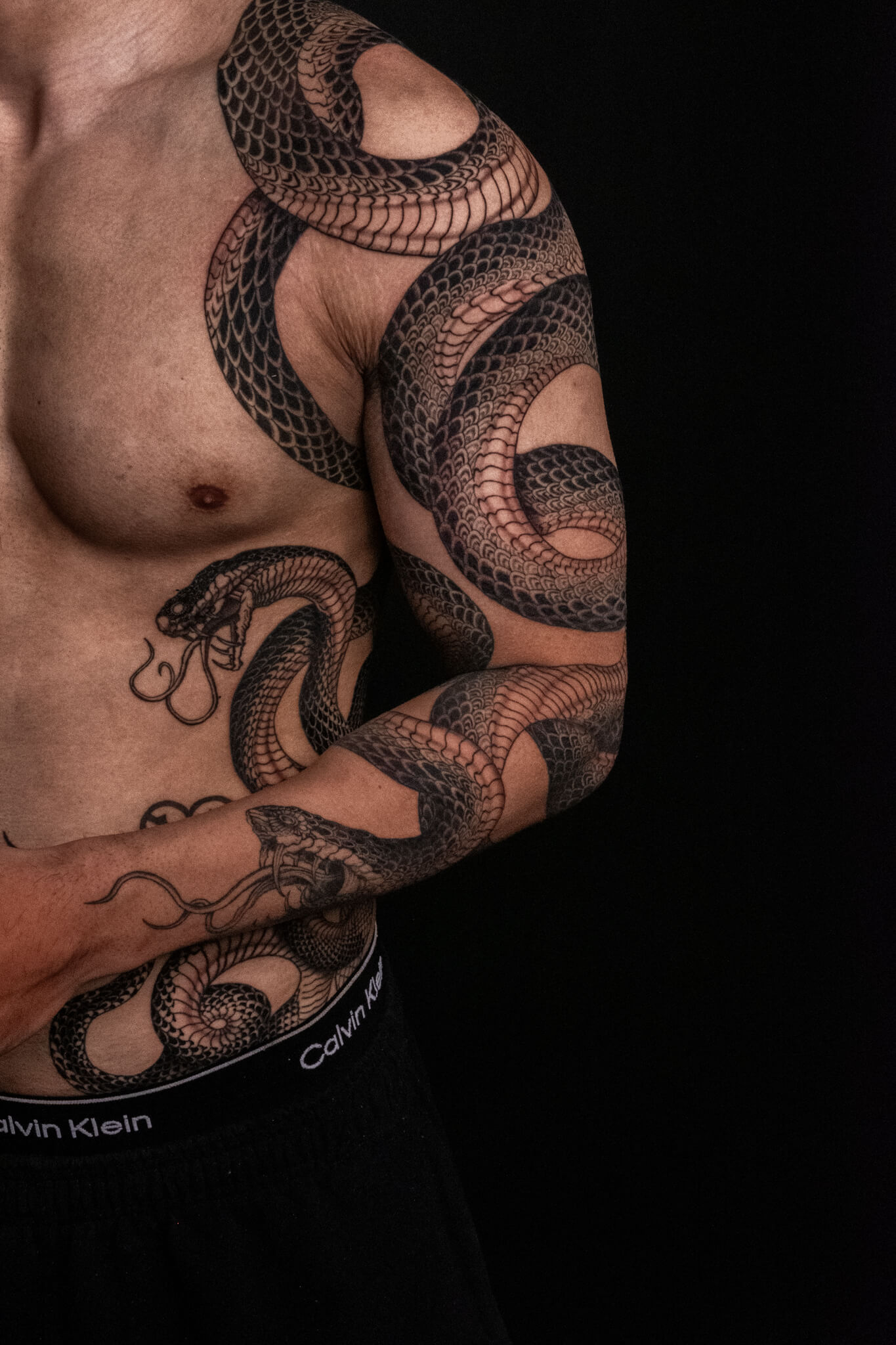
Direct answer (40–60 words): Snake sleeve tattoos in Eastern design systems follow natural muscle lines to create visual flow and narrative continuity. The snake is often positioned to move from shoulder to wrist or vice versa, symbolizing life progression, energy movement, or spiritual transformation depending on direction and surrounding elements.
In traditional sleeve design, artists carefully map snake curvature to anatomical structure. This ensures that bends align with elbows and wrists rather than disrupting visual continuity. This technique is a hallmark of advanced irezumi-inspired composition.
Common design principle checklist:
- Maintain uninterrupted flow across joints
- Align movement with natural muscle direction
- Integrate background elements (water, wind, flora)
Information Gain Insight: One overlooked technique in high-level tattoo design is “directional storytelling,” where snake movement subtly indicates life direction—upward for growth, downward for grounding or reflection.
Modern Interpretations of Eastern Snake Tattoos
Direct answer (40–60 words): Modern Eastern snake tattoos blend traditional symbolism with contemporary aesthetics, creating neo-traditional and fusion styles. These designs retain cultural meanings like transformation and protection while adapting to global tattoo trends, including minimalist linework, abstract forms, and personalized symbolic combinations.
Global tattoo culture has significantly expanded interpretation of Eastern snake symbolism. While traditional meanings remain foundational, modern artists often incorporate personal narratives, combining Eastern philosophy with Western visual minimalism or abstract art styles.
For example, a modern snake tattoo might include geometric overlays or negative space design while still preserving traditional symbolic meaning such as transformation or balance. This fusion allows individuals to personalize ancient symbolism without losing cultural depth.
Neo-Traditional vs Classic Asian Style
Direct answer (40–60 words): Neo-traditional snake tattoos combine Eastern symbolism with modern shading, color gradients, and stylistic freedom, while classic Asian tattoos follow strict composition rules rooted in cultural tradition. The key difference lies in artistic flexibility versus symbolic structure, though both maintain core meanings of transformation and protection.
Neo-traditional designs often appeal to younger audiences seeking cultural symbolism without strict adherence to historical rules. Classic Asian styles, however, prioritize narrative consistency, flow discipline, and symbolic accuracy.
- Neo-traditional: artistic freedom, modern shading, fusion styles
- Classic Asian: structured flow, cultural storytelling, strict symbolism
Experts in tattoo anthropology note that both styles are now coexisting rather than competing, reflecting the globalization of Eastern symbolic systems.
FAQ: Eastern Snake Tattoo Meaning
Direct answer (40–60 words): The following FAQs address the most common questions about Eastern snake tattoo meanings, including symbolism, cultural interpretation, and design considerations. These answers reflect both traditional Asian perspectives and modern tattoo practices used by professional artists worldwide.
- What does an eastern snake tattoo symbolize? Transformation, protection, wisdom, and spiritual renewal across East Asian cultures.
- Is a snake tattoo bad luck in Asian culture? No, in most Eastern traditions snakes symbolize intelligence and protection rather than bad luck.
- What does a Japanese snake tattoo mean? It represents healing, protection from misfortune, and resilience.
- What does a snake in Chinese culture represent? Intelligence, intuition, and zodiac-based personality traits.
- Do snake tattoos mean crime or danger? No, that is a Western misconception not rooted in traditional Eastern symbolism.
- Does tattoo placement change meaning? Yes, placement affects flow and symbolic interpretation significantly.
- What animals pair well with snake tattoos? Tigers, peonies, daggers, and waves are commonly used to create layered meaning.
Conclusion: The Living Symbolism of Eastern Snake Tattoos
Direct answer (40–60 words): Eastern snake tattoos are dynamic symbols of transformation, wisdom, and protection shaped by cultural, philosophical, and design contexts. Their meaning is not fixed but evolves through composition, placement, and cultural interpretation, making them one of the most versatile and deeply symbolic tattoo choices in Eastern body art traditions.
The true strength of Eastern snake tattoo symbolism lies in its adaptability. Whether drawn through the lens of Japanese irezumi tradition or Chinese zodiac philosophy, the snake remains a living symbol—one that reflects personal transformation as much as cultural heritage.