What Is a Half Sleeve Tattoo?
A half sleeve tattoo is a large-scale arm design that typically covers either the shoulder to elbow or elbow to wrist. It is not a single image but a coordinated composition built across multiple sessions. Professional tattoo artists design it to follow arm anatomy, ensuring visual flow, balance, and long-term aesthetic consistency.
In professional tattooing, a half sleeve is treated as a “compositional project” rather than a standalone tattoo. This means artists plan negative space, shading gradients, and focal points based on how the arm moves. Unlike small tattoos, it requires structural planning similar to visual storytelling across skin.
Upper Arm vs Lower Arm Half Sleeve Placement
Upper arm and lower arm half sleeves differ in visibility, pain sensitivity, and design flow. Upper arm sleeves are easier to conceal and often allow denser shading, while forearm sleeves are more visible and interact more with daily movement. The best choice depends on lifestyle, profession, and aesthetic priorities.
Experienced tattoo artists often recommend upper arm sleeves for first-time clients due to reduced pain sensitivity and better design continuity. Forearm sleeves, however, require more precise alignment because muscle rotation affects how the tattoo appears when the arm bends or twists.
- Upper arm: lower visibility, higher design flexibility
- Forearm: higher visibility, more exposure to fading
- Elbow zone: most distortion-prone area
Expert Insight: Many poorly executed sleeves fail not because of artistry, but because the design ignores how the arm contracts during movement.
Best Half Sleeve Tattoo Styles & Design Ideas
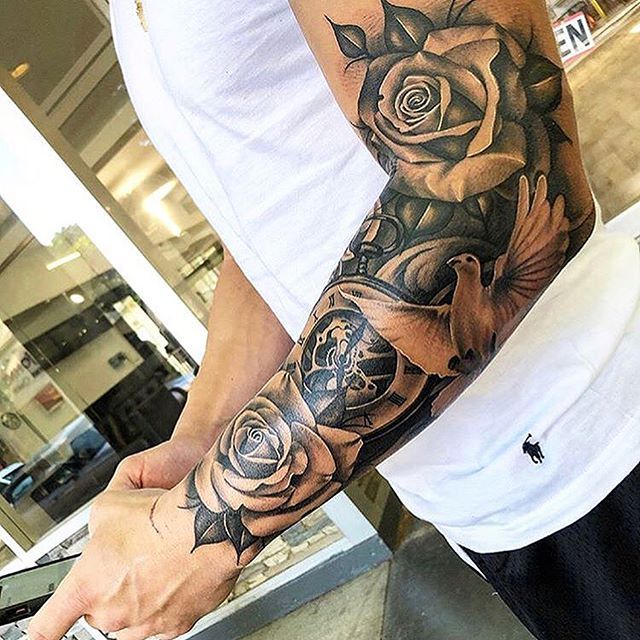
Half sleeve tattoo styles range from realism and Japanese-inspired compositions to minimalist and abstract designs. The best style depends on personal storytelling, skin tone, and long-term aging behavior. Artists emphasize cohesion, meaning that all elements must visually connect instead of appearing as separate tattoos placed side by side.
Modern tattoo design prioritizes longevity. Styles with strong line structure and controlled shading tend to age better than overly detailed micro-realism. A well-designed sleeve should still be readable from a distance after 10–15 years of natural fading and skin aging.
Black and Grey Realism Sleeve Concepts
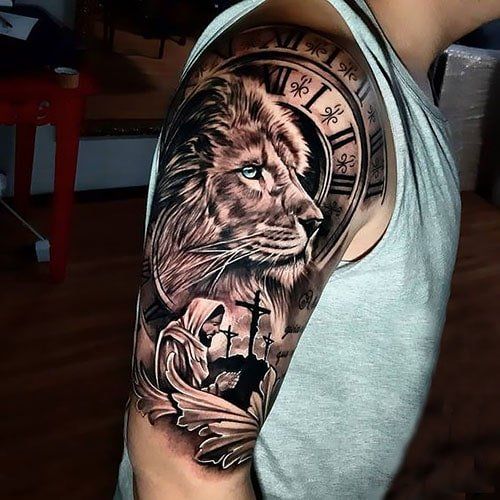
Black and grey realism sleeves use shading depth and contrast to create lifelike imagery without color distraction. This style is ideal for portraits, symbolic objects, or storytelling scenes. It requires advanced technical skill because poor shading transitions can make the design appear blurred as the skin heals over time.
Professional artists often build realism sleeves using layered sessions. Background shading is completed first, followed by mid-tones and detail work. This prevents ink saturation overload and allows controlled healing between stages.
- Best for: portraits, clocks, religious imagery, memorial tattoos
- Key requirement: smooth gradient control
- Risk factor: over-detailing reduces long-term clarity
Common misconception: More detail does not equal better tattoo. In realism, contrast control is more important than density.
Japanese Irezumi-Inspired Half Sleeve Designs
Japanese-inspired sleeves follow a structured visual flow system known as Irezumi composition. These designs typically feature waves, koi fish, dragons, or floral motifs arranged to move naturally with the arm’s muscle structure. Each element carries symbolic meaning tied to strength, resilience, and transformation.
Unlike Western tattoo styles, Japanese sleeves prioritize background flow over isolated focal points. The empty space (negative space) is as important as the inked area, creating balance and motion across the skin surface.
- Koi fish: perseverance and transformation
- Dragons: power and wisdom
- Waves: life struggle and movement
Expert Insight: Traditional Japanese sleeves are designed like armor for the body, not decoration.
Half Sleeve Tattoo Pain Level Explained
Pain levels for half sleeve tattoos vary significantly depending on nerve density, skin thickness, and bone proximity. Areas like the outer shoulder and upper bicep are less painful, while inner elbow and forearm near the wrist are more sensitive due to higher nerve concentration and thinner skin layers.
Pain is not uniform across the arm, and experienced artists adjust session duration based on client tolerance. Proper hydration, rest, and controlled breathing significantly reduce perceived pain intensity during long tattoo sessions.
Most Painful vs Least Painful Arm Areas
Pain distribution in a half sleeve tattoo follows anatomical sensitivity rather than size. Bone-proximate areas such as elbows and wrists generate sharper pain responses, while muscle-dense regions like the outer bicep are more tolerable. Understanding this helps clients mentally prepare for longer sessions.
Professional tattooists often start with low-pain zones to help clients acclimate before moving into more sensitive regions. This pacing strategy improves endurance and reduces early session dropout rates.
- Low pain: outer shoulder, outer bicep
- Moderate pain: forearm outer region
- High pain: inner elbow, wrist, inner arm
Information Gain: Pain tolerance improves after the first 60–90 minutes due to endorphin release, which is why longer sessions often feel easier over time.
Pain Management Techniques Used by Professionals
Professional tattoo artists use structured techniques to manage pain during half sleeve sessions. These include scheduled breaks, controlled breathing guidance, hydration optimization, and session segmentation. Proper preparation significantly reduces discomfort and improves ink quality due to reduced muscle tension.
Many studios also recommend avoiding caffeine and alcohol before sessions because both can increase skin sensitivity and bleeding, which negatively affects pigment retention and healing outcomes.
- Hydrate 24–48 hours before session
- Avoid blood-thinning substances
- Use breathing rhythm control during needle contact
Expert Note: Calm muscle tension leads to cleaner ink placement, reducing the need for future touch-ups.
Lucky Tattoo, a professional tattoo artist, has over 10 years of experience in the art of tattooing in Ho Chi Minh City. Lucky Tattoo Studio was founded in 2014 by skilled and kind artists. All tattoos are provided in a clean, strictly controlled, and friendly environment.
Half Sleeve Tattoo Cost Breakdown (What You Actually Pay For)
A half sleeve tattoo typically costs between $300 and $2000+, depending on artist experience, design complexity, geography, and session length. Pricing is usually calculated hourly, with highly skilled artists charging significantly more due to precision, hygiene standards, and demand. The total cost also reflects multiple sessions rather than a single appointment.
Cost is not only about size—it reflects technical difficulty, shading depth, and revision work. Highly detailed realism or Japanese-style sleeves require more planning and longer execution time, increasing overall investment. Cheap sleeves often result in inconsistent shading, uneven healing, and costly future corrections.
Hourly Pricing vs Full Sleeve Project Pricing
Half sleeve tattoos are priced either hourly or as full project packages. Hourly rates range widely based on artist reputation, typically from mid-tier studio pricing to elite specialists. Project pricing provides more predictability but requires clear upfront design agreement between client and artist.
Experienced tattoo professionals prefer project-based pricing for sleeves because it ensures consistency in design execution across multiple sessions. This avoids stylistic drift that can occur when sessions are spaced too far apart or performed by different artists.
- Hourly: flexible, unpredictable final cost
- Project-based: fixed scope, higher design consistency
- Top-tier artists: higher cost but stronger longevity results
Information Gain: Most cost overruns occur not from tattooing itself, but from redesign adjustments caused by poor initial planning.
Why Complex Designs Increase Long-Term Cost
Complex designs increase cost because they require more layering, stencil refinement, and correction passes. Elements like realism shading, color blending, and intricate background structures require multiple healing intervals between sessions to prevent skin trauma and ink saturation issues.
Additionally, artists must account for skin behavior over time. Areas like elbows and inner arms stretch and compress, requiring design adjustments that increase planning complexity and execution time.
Tattoo Healing Process & Aftercare Timeline
Tattoo healing occurs in multiple biological stages over 2–4 weeks for surface recovery and up to 3 months for deep dermal stabilization. Proper aftercare reduces infection risk, preserves ink clarity, and prevents premature fading. Healing success depends on hygiene, moisture balance, and avoiding mechanical skin damage during recovery.
The dermis layer of the skin holds the ink, while the epidermis regenerates and sheds during healing. Mismanaging this process—such as over-moisturizing or picking scabs—can permanently damage pigment retention and lead to patchy or blurred tattoos.
4 Healing Stages of a Half Sleeve Tattoo
Healing progresses through inflammation, scabbing, peeling, and stabilization phases. Each stage requires different care practices. Early inflammation is normal, while peeling and itching indicate skin regeneration. Full stabilization occurs when ink settles into the dermis and skin texture normalizes.
Improper care during peeling is one of the most common causes of uneven tattoo healing. Clients often mistake peeling skin for ink loss and attempt to “fix” it, causing unnecessary trauma to the healing layer.
- Days 1–3: inflammation and sensitivity
- Days 4–10: scabbing and peeling phase
- Weeks 2–4: surface healing completion
- Months 1–3: deep skin stabilization
Expert Insight: Most tattoo fading issues originate in the first 10 days due to improper aftercare, not artist error.
Infection Prevention & Skin Safety Guidelines
Infection prevention relies on sterile technique and disciplined aftercare. Professional studios follow strict hygiene protocols including sterilized equipment, single-use needles, and disinfected surfaces. Clients must maintain cleanliness and avoid exposure to bacteria-rich environments during healing.
Medical guidance from dermatological authorities emphasizes avoiding swimming pools, direct sunlight, and tight clothing during early healing stages to reduce infection risk and pigment disruption.
- Clean tattoo gently with fragrance-free soap
- Apply thin layers of recommended ointment
- Avoid scratching or peeling scabs
Safety Note: According to dermatology research, improper aftercare significantly increases risk of localized skin infection and pigment loss.
How to Plan a Cohesive Half Sleeve Tattoo
A cohesive half sleeve tattoo is designed as a unified visual system rather than separate tattoo pieces. Planning involves selecting a central theme, establishing visual flow, and ensuring each element connects naturally through shading, spacing, and directional movement aligned with arm anatomy.
Without planning, sleeves often appear fragmented and visually chaotic over time. Professional tattoo artists use composition principles similar to graphic design, ensuring balance between focal points, negative space, and directional flow across muscle movement.
Theme Selection Strategy (Story-Based Design)
Theme selection determines the emotional and visual coherence of a half sleeve tattoo. Strong sleeves are built around storytelling concepts such as mythology, nature cycles, or personal milestones. Each tattoo element should reinforce the central narrative rather than exist independently.
Artists often reject “random collection” sleeves because they lack long-term visual unity. Instead, structured storytelling ensures the tattoo remains meaningful and visually consistent even decades after healing and fading.
- Mythology: gods, warriors, symbolic power
- Nature: animals, seasons, growth cycles
- Personal: life events, milestones, memories
Information Gain: The strongest sleeves follow a 3-layer narrative structure—foreground subject, mid-layer motion, and background atmosphere.
Arm Anatomy Flow Mapping for Better Design
Arm anatomy mapping ensures tattoos move naturally with muscle contraction and joint rotation. Skilled artists design sleeves based on how the deltoid, bicep, and forearm muscles expand and compress during movement, preventing distortion and improving long-term readability of the tattoo.
Ignoring anatomy leads to warped designs, especially around the elbow and inner arm. Flow mapping ensures that key visual elements remain recognizable even when the arm is fully bent or extended.
- Shoulder: primary focal anchor
- Bicep: transitional flow zone
- Elbow: distortion control zone
Choosing the Right Tattoo Artist for a Half Sleeve
Choosing the right tattoo artist determines the success of a half sleeve tattoo more than any other factor. Expertise, style specialization, hygiene standards, and portfolio consistency all influence final results. A skilled artist understands composition, skin behavior, and long-term ink aging dynamics.
Many clients mistakenly prioritize price or social media popularity instead of technical ability. However, sleeves require advanced planning skills that only experienced professionals can execute consistently across multiple sessions.
Portfolio Evaluation Checklist
A professional portfolio should demonstrate consistent line quality, healed tattoo results, and style specialization. Evaluating healed work is critical because fresh tattoos often look sharper than their long-term outcome. This helps predict how the tattoo will age over time.
Look for consistency across multiple clients rather than isolated high-quality pieces. This indicates stable technique rather than occasional success.
- Check healed tattoo photos, not just fresh work
- Look for consistent shading depth
- Evaluate sleeve flow continuity
Expert Insight: A strong tattoo portfolio shows aging results, not just Instagram-ready images.
Consultation Questions You Should Always Ask
Consultation is a critical step in sleeve tattoo planning. It allows clients to evaluate communication style, technical knowledge, and design approach. The best artists provide structured feedback and realistic expectations rather than agreeing to all requests without critique.
Asking the right questions prevents misalignment in design expectations and ensures better long-term satisfaction with the final tattoo outcome.
- How will the design flow with my arm movement?
- What aftercare protocol do you recommend?
- How many sessions will this require?
FAQ: Half Sleeve Tattoo (Expert Answers)
A half sleeve tattoo FAQ addresses common concerns about cost, pain, healing, design choices, and long-term care. These answers help users make informed decisions quickly and reduce uncertainty before committing to a multi-session tattoo project involving significant time and financial investment.
How long does a half sleeve tattoo take?
Most half sleeve tattoos take 2 to 6 sessions depending on complexity, typically spread over several weeks or months to allow proper healing between appointments.
Is a half sleeve tattoo very painful?
Pain varies by arm area. Outer arm regions are moderate, while inner elbow and wrist areas are significantly more sensitive due to nerve concentration.
How much does a high-quality half sleeve cost?
A professional half sleeve generally costs between $300 and $2000+, depending on artist expertise, detail level, and geographic location.
What tattoo style lasts longest on a sleeve?
Bold line styles such as traditional, blackwork, and Japanese-inspired designs tend to age better than ultra-fine realism due to stronger structural definition.
How do you properly care for a new half sleeve tattoo?
Clean gently, avoid scratching, keep moisturized lightly, and avoid sun exposure or swimming during the initial 2–4 week healing period.
Final Expert Takeaway
A successful half sleeve tattoo is not just about design—it is a long-term integration of anatomy, storytelling, and skin science. When properly planned with expert guidance, it becomes a durable visual narrative that evolves with the body while maintaining clarity, meaning, and artistic integrity over time.
Lucky Tattoo, a professional tattoo artist, has over 10 years of experience in the art of tattooing in Ho Chi Minh City. Lucky Tattoo Studio was founded in 2014 by skilled and kind artists. All tattoos are provided in a clean, strictly controlled, and friendly environment.
half-sleeve-tattoo