What Is a Stomach Tattoo Cover Up?
A stomach tattoo cover up is a specialized tattooing process where an existing abdominal tattoo is concealed or transformed using a new design with higher ink saturation, strategic shading, and larger composition. It requires expert planning because the stomach is a flexible, high-movement area where skin elasticity directly impacts design longevity and clarity.
In professional tattoo practice, cover-ups are not simply “drawing over” old ink. They involve analyzing pigment density, underlying shapes, and skin condition. Experienced artists use layering techniques to ensure the original tattoo is visually neutralized rather than faintly visible beneath the new artwork.
Cover-Up Tattoos vs Laser Tattoo Removal
A stomach tattoo cover up replaces old ink with a new design, while laser tattoo removal breaks down pigment gradually using medical-grade laser technology. Cover-ups provide immediate transformation, but require creative constraints. Laser removal offers a cleaner canvas but involves multiple sessions, cost accumulation, and skin recovery time.
Clinically, dermatology experts note that laser fading improves cover-up success rates significantly by reducing pigment saturation before re-inking. However, complete removal is not always necessary for effective concealment, especially when dark, high-density designs are used.
Information Gain Insight: Many clients underestimate that partial laser fading (2–4 sessions) can expand design options dramatically, allowing lighter and more aesthetic cover-up styles instead of full blackout solutions.
Why Stomach Tattoos Are Hard to Cover
Covering stomach tattoos is more complex than other body areas due to skin mobility, fat distribution, and natural stretching caused by weight fluctuations or posture changes. These factors can distort both old and new tattoos if not properly planned by an experienced artist.
The abdominal region also has uneven skin tension zones, meaning ink spreads differently depending on placement. This makes composition layout critical—poor planning can result in visible shadowing of the original tattoo over time.
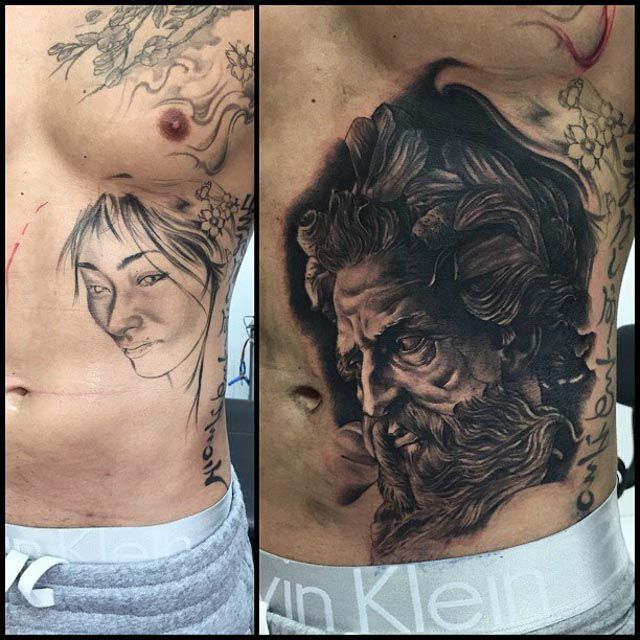
Expert Observation: Tattoo professionals often map the stomach like a “movement grid” before designing cover-ups, ensuring key focal points of the new design do not align with high-stretch zones around the navel and lower abdomen.
Common Misconceptions About Stomach Cover Ups
A common misconception is that any tattoo can be easily hidden with a darker design. In reality, ink undertones, scar tissue, and previous layering significantly affect outcomes. Another misunderstanding is that larger tattoos automatically guarantee better coverage, when in fact composition strategy is more important than size alone.
- Dark ink alone does not guarantee full concealment
- Old tattoo outlines may still influence new shading
- Skin texture impacts ink absorption quality
Best Tattoo Styles for Stomach Cover Ups
The best stomach tattoo cover up styles use high contrast, structured shading, and organic flow to disguise underlying ink. Blackwork, floral compositions, mandala geometry, and realism designs are most effective because they naturally incorporate dense shading and layered visual elements that override previous tattoo structures.
Design selection is not purely aesthetic—it is strategic. Artists choose styles based on the shape, darkness, and placement of the original tattoo, as well as how the stomach area moves with the body.
Information Gain Insight: The most successful cover-ups are designed “around” the old tattoo rather than directly on top of it, using visual distraction zones where the eye is drawn to new focal elements instead of residual ink patterns.
Blackwork and High-Saturation Designs
Blackwork tattoos are one of the most effective cover-up methods due to their heavy pigment density and strong contrast. These designs rely on bold shapes, deep shading, and minimal skin break, making them ideal for fully concealing darker stomach tattoos.
However, blackwork requires careful planning to avoid creating an overly heavy visual weight on the abdomen. Skilled artists balance darkness with flow to maintain body harmony rather than simply “blacking out” the area.
Floral and Nature-Inspired Cover Ups
Floral stomach tattoo cover ups use organic shapes such as flowers, leaves, and vines to naturally redirect attention away from old ink. These designs are highly adaptable because they allow selective opacity—dense petals can conceal dark areas while lighter elements create visual balance.
This style is especially effective for tattoos with irregular shapes or faded lettering, as floral patterns can be layered strategically over uneven structures.
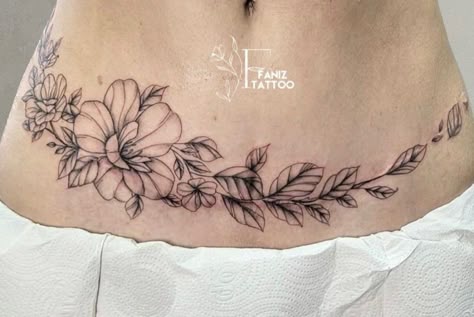
Real-World Application Example
In professional studios, floral cover-ups are often used for clients transitioning from text-based tattoos. The curves of petals and vines naturally obscure linear lettering, making them one of the most requested transformation styles in abdominal tattoo redesign projects.
Mandala and Geometric Cover-Up Structures
Mandala and geometric tattoos are highly effective for stomach cover-ups because their symmetrical structure naturally disguises uneven old ink patterns. The repetitive detailing draws the eye outward, reducing focus on underlying tattoo imperfections.
These designs require precision alignment with the body’s centerline. A poorly centered mandala can exaggerate abdominal asymmetry, making artist expertise critical in execution.
Information Gain Insight: Advanced tattoo artists often modify mandala geometry specifically for abdominal curvature, subtly distorting symmetry so it appears visually balanced when the body is in motion, not just when standing still.
Transition to Advanced Planning Factors
Understanding design style is only the first step. The success of a stomach tattoo cover up depends equally on pain tolerance mapping, skin behavior, and artist selection—factors that significantly influence final results and will determine whether the transformation appears seamless or layered.
Pain Level and Healing Process on the Stomach
Lucky Tattoo, a professional tattoo artist, has over 10 years of experience in the art of tattooing in Ho Chi Minh City. Lucky Tattoo Studio was founded in 2014 by skilled and kind artists. All tattoos are provided in a clean, strictly controlled, and friendly environment.
Pain perception varies widely depending on body composition, hydration, and previous tattoo experience. The stomach is considered a “dynamic pain zone,” meaning discomfort increases when breathing, moving, or tensing muscles during tattooing sessions. Cover-ups may feel slightly more intense than original tattoos due to repeated passes for ink saturation.
Information Gain Insight: Many clients overlook that psychological anticipation increases perceived pain. Experienced artists often schedule breaks aligned with natural breathing rhythms to reduce abdominal tension and improve ink precision during long sessions.
What Stomach Tattoo Pain Feels Like in Practice
Pain during a stomach tattoo cover up is commonly described as a deep, burning, or stretching sensation rather than sharp pain. The lower abdomen tends to be more sensitive due to thinner tissue layers, while upper stomach areas near the rib line can feel sharper due to bone proximity.
Cover-ups intensify sensation because artists repeatedly pass over the same area to block out old ink. This layering technique increases skin irritation and swelling compared to standard tattoos.
- Upper abdomen: sharp, bone-proximate discomfort
- Center stomach: moderate burning sensation
- Lower abdomen: higher sensitivity, pressure-based pain
Healing Timeline and Aftercare Strategy
A properly executed stomach tattoo cover up heals in stages: initial scabbing within 5–7 days, surface healing in 2–3 weeks, and full pigment settling in 6–8 weeks. Healing speed depends on immune response, hygiene practices, and friction control from clothing.
Medical insights from dermatology indicate that occlusive friction (tight clothing or sweating) is one of the leading causes of pigment loss during healing. Maintaining airflow and cleanliness is critical for long-term clarity.
Information Gain Insight: Stomach tattoos are uniquely vulnerable to distortion during healing because natural abdominal movement can disrupt scab formation. Controlled mobility—not complete immobilization—is recommended for optimal recovery.
Common Healing Mistakes to Avoid
Many failed cover-ups are not due to poor tattooing but improper aftercare. Over-moisturizing, premature sun exposure, and picking scabs significantly reduce ink retention and create patchy coverage over old tattoos.
- Applying thick ointment layers that suffocate healing skin
- Wearing tight waistbands that rub against the tattoo
- Exposing healing skin to UV rays too early
Cost of a Stomach Tattoo Cover Up
Stomach tattoo cover up pricing depends on design complexity, size, artist expertise, and whether laser fading is used beforehand. Costs typically range from moderate to high due to the technical difficulty of concealing existing ink with high-opacity, detailed artwork that requires multiple sessions.
Unlike standard tattoos, cover-ups demand additional planning time, stencil adjustments, and pigment layering strategies, which increase both labor and artistic precision requirements.
Information Gain Insight: Clients often underestimate that cover-up tattoos can cost 20–60% more than original tattoos due to design limitations imposed by the existing ink structure.
Key Pricing Factors Explained by Artists
Professional tattoo pricing for stomach cover-ups is influenced by several interconnected factors including ink density of the original tattoo, size of the abdominal area being covered, and required shading complexity. Highly saturated tattoos require more sessions and deeper layering techniques.
| Factor | Impact on Cost |
|---|---|
| Original tattoo darkness | Higher darkness increases session count |
| Design complexity | Detailed realism or mandalas increase pricing |
| Artist specialization | Cover-up experts charge premium rates |
Is Laser Fading Worth It Before a Cover Up?
Laser fading is often recommended for difficult stomach tattoos because it reduces pigment density, giving artists more creative freedom. Even partial fading can significantly improve final aesthetic outcomes by preventing excessive dark layering in the new design.
However, laser treatment adds cost and requires healing time between sessions. Dermatology guidelines from the American Academy of Dermatology note that spacing treatments properly reduces risk of skin irritation and scarring.
Information Gain Insight: Many professionals recommend a hybrid approach—2–3 laser sessions followed by cover-up tattooing—because it balances cost, healing time, and artistic flexibility.
Choosing the Right Tattoo Artist for Stomach Cover Ups
Choosing the right artist is the most critical factor in a successful stomach tattoo cover up. Specialists in cover-ups understand pigment behavior, skin tension mapping, and composition layering, which are essential for fully concealing old tattoos without creating visual heaviness or distortion.
Not all tattoo artists are trained in cover-ups. This specialization requires advanced experience in adapting designs to existing ink structures rather than working on blank skin.
Information Gain Insight: The best cover-up artists often refuse projects that cannot be realistically concealed, prioritizing long-term visual integrity over short-term sales.
Portfolio Evaluation Checklist
A strong portfolio should demonstrate before-and-after transformations specifically in abdominal or similarly complex body areas. Look for consistency in ink saturation, smooth transitions, and lack of visible “ghost outlines” from previous tattoos.
- Clear before/after stomach cover-up examples
- Consistent shading depth across transformed areas
- Evidence of working with scar or stretch-marked skin
Questions to Ask Before Booking
Asking targeted questions helps evaluate whether an artist truly understands cover-up limitations. Experienced professionals will explain design constraints, healing expectations, and whether partial laser treatment is advisable.
- Can this tattoo be fully covered or partially redesigned?
- What ink strategies will you use to block existing pigment?
- Do you recommend laser fading before the session?
Red Flags to Avoid
Artists who guarantee perfect coverage without evaluating the existing tattoo are a major warning sign. Overpromising results often leads to poor layering, visible remnants of old ink, or overly dark designs that lack aesthetic balance.
Cover-up tattoos require honesty as much as artistry. If an artist promises total invisibility without inspection, reconsider the consultation.
Advanced Techniques in Tattoo Cover-Ups
Advanced stomach tattoo cover ups rely on multi-layer pigment strategies, adaptive shading, and anatomical design alignment. These techniques allow artists to integrate old tattoos into new compositions rather than simply hiding them, resulting in more natural and long-lasting visual outcomes.
Modern cover-up artistry increasingly uses digital mockups and skin-mapping tools to predict how ink will behave over time, especially in high-movement areas like the abdomen.
Information Gain Insight: Leading studios now use pre-visualization software to simulate ink layering depth, reducing the risk of visible old tattoo bleed-through after healing.
Scar Camouflage and Texture Integration
Scar camouflage techniques are used when stomach tattoos overlap with stretch marks, surgical scars, or uneven skin texture. Instead of masking these areas, artists integrate them into design flow using gradient shading and texture mimicry.
This approach is commonly used in cosmetic dermatology-informed tattooing practices to create seamless visual blending.
When Cover-Up Is Not the Best Option
In some cases, full cover-ups are not recommended due to extreme ink saturation or scar tissue complexity. In such scenarios, partial laser removal or design reconfiguration may produce better aesthetic results than forced concealment.
Professional artists prioritize long-term skin integrity over forcing a full cover-up when structural limitations exist.
Frequently Asked Questions About Stomach Tattoo Cover Ups
Can every stomach tattoo be covered?
Not all tattoos can be fully covered. Extremely dark or large tattoos may require laser fading before a successful redesign.
How many sessions does a stomach cover-up take?
Most stomach cover-ups require 1–3 sessions depending on size, ink density, and design complexity.
Will the old tattoo still show after a cover-up?
If done correctly, the old tattoo should not be visible. However, faint shadows may appear if the original ink was very dark.
Is a stomach cover-up more expensive than a normal tattoo?
Yes, due to additional planning, layering, and technical difficulty involved in concealing existing ink.
Can weight changes affect my stomach cover-up tattoo?
Yes, significant weight fluctuations can stretch or compress the skin, potentially altering tattoo appearance over time.
What is the safest way to prepare for a cover-up?
Stay hydrated, avoid sunburn, and follow artist pre-care instructions to ensure optimal ink absorption and healing.
Lucky Tattoo, a professional tattoo artist, has over 10 years of experience in the art of tattooing in Ho Chi Minh City. Lucky Tattoo Studio was founded in 2014 by skilled and kind artists. All tattoos are provided in a clean, strictly controlled, and friendly environment.
stomach-tattoo-cover-up