Geometric tattoos have evolved from a niche artistic style into one of the most technically demanding and visually striking forms of modern body art. Defined by precise lines, mathematical balance, symmetry, and pattern repetition, geometric tattoos appeal to people seeking designs that combine aesthetics, symbolism, and craftsmanship. From sacred geometry and mandalas to abstract blackwork sleeves and geometric animals, these tattoos offer nearly limitless creative possibilities.
What separates a truly exceptional geometric tattoo from an average one is not complexity alone. Precision, anatomical flow, spacing, line consistency, and long-term readability all determine whether a design remains impressive years after it heals. This guide explores not only popular geometric tattoo ideas but also the overlooked factors that influence longevity, symbolism, artist selection, and design success.
What Is a Geometric Tattoo?
A geometric tattoo is a tattoo style built around shapes, lines, symmetry, patterns, and mathematical relationships. Unlike illustrative or traditional tattoos that rely primarily on imagery, geometric tattoos use visual structure to create balance, meaning, and aesthetic impact through precise composition.
At its core, geometric tattooing transforms mathematical principles into wearable art. Circles, triangles, polygons, repeating patterns, and sacred geometry symbols form the foundation of many designs. Some tattoos focus purely on aesthetics, while others incorporate deep symbolic and spiritual meaning.
Modern geometric tattoos can range from a minimalist triangle on the wrist to a full-body composition incorporating thousands of precisely placed dots and interconnected shapes.
Popular geometric tattoo categories include:
- Sacred geometry tattoos
- Mandala tattoos
- Geometric animal tattoos
- Dotwork tattoos
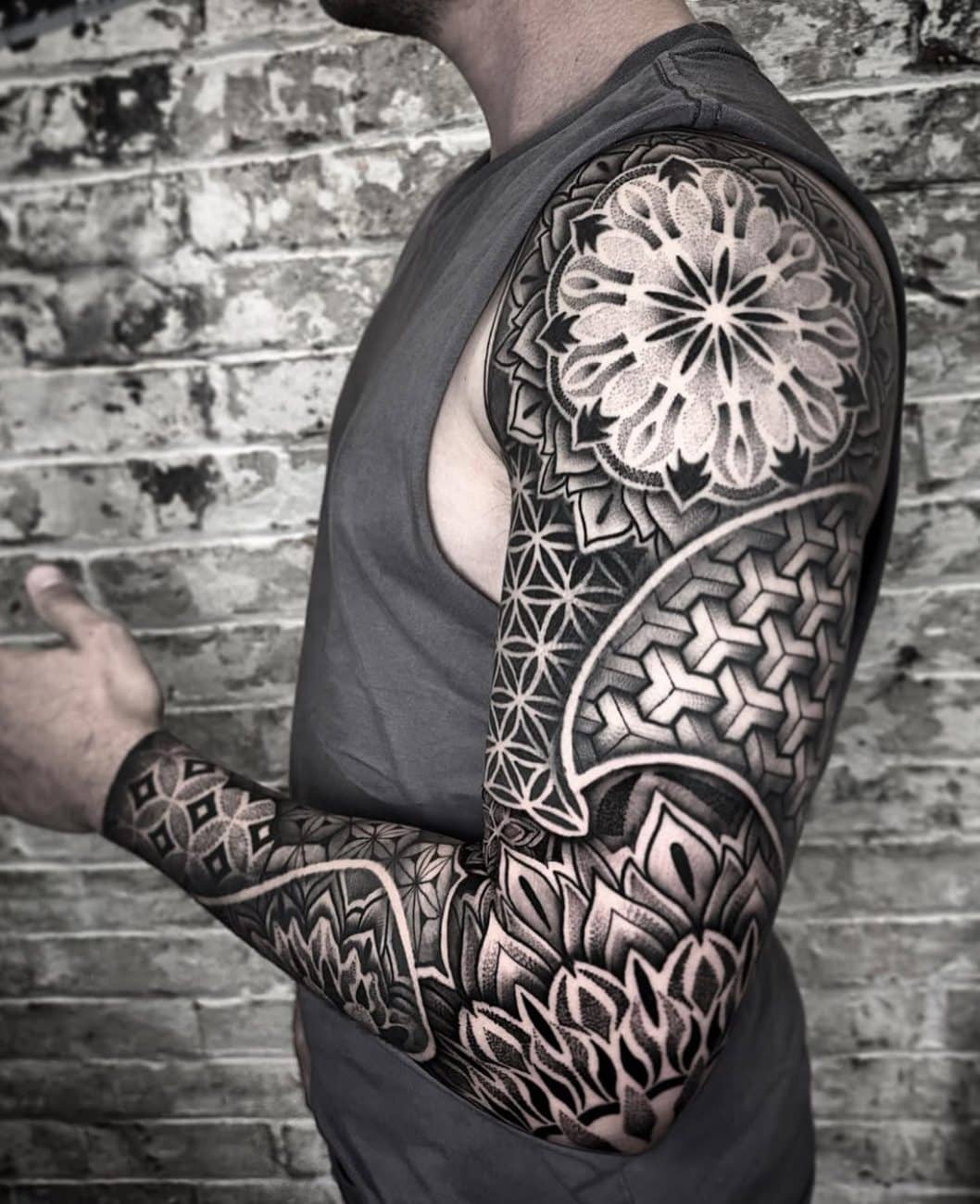
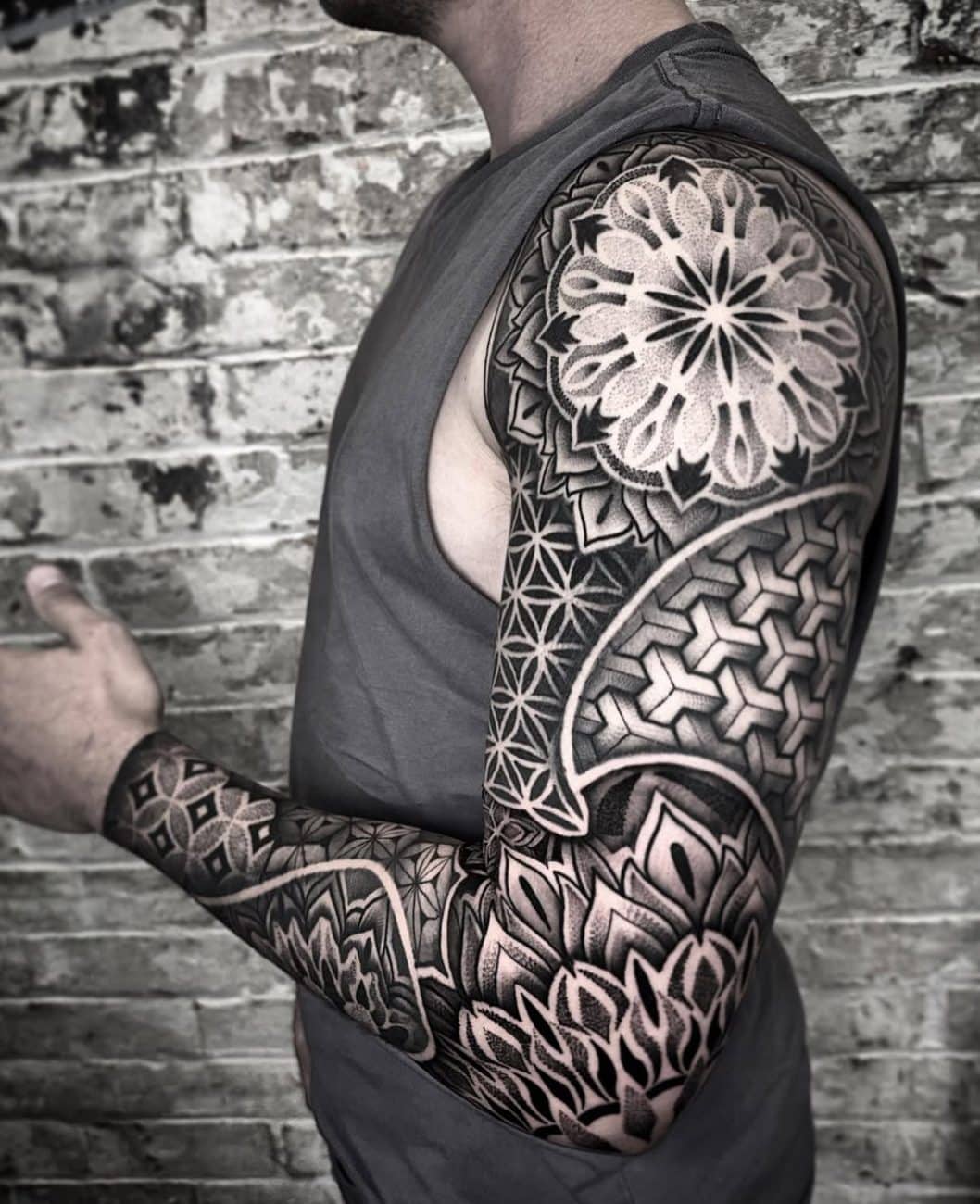
- Blackwork geometric sleeves
- Minimalist geometric designs
- Abstract geometric compositions
Expert Observation: One overlooked reality is that geometric tattoos are among the least forgiving tattoo styles. Minor inconsistencies that might go unnoticed in traditional tattoos become immediately visible when symmetry is involved.
How Geometric Tattoos Differ From Traditional Tattoos
Geometric tattoos prioritize precision, mathematical balance, and structural design, whereas traditional tattoos emphasize imagery, bold outlines, and illustrative storytelling. The technical demands and design principles differ significantly between the two styles.
Traditional tattoos typically focus on recognizable subjects such as roses, eagles, skulls, or portraits. Geometric tattoos often communicate through visual harmony rather than literal imagery.
| Geometric Tattoos | Traditional Tattoos |
|---|---|
| Symmetry-focused | Image-focused |
| Mathematical layouts | Illustrative layouts |
| Precise linework | Bold outlines |
| Pattern repetition | Subject storytelling |
| Technical accuracy critical | More forgiving execution |
The challenge for artists lies in maintaining perfect consistency across curved body surfaces. A geometric design that appears flawless on paper may require significant adaptation to fit the contours of a shoulder, calf, or forearm.
Why Symmetry Matters in Geometric Tattoo Design
Symmetry creates visual balance, harmony, and order, making it one of the defining characteristics of successful geometric tattoos. Even slight deviations can disrupt the intended effect and become noticeable over time.
Human brains naturally recognize patterns and proportional relationships. Symmetrical designs often feel calming and aesthetically pleasing because they mirror structures found throughout nature, architecture, and mathematics.
Professional geometric tattoo artists frequently spend more time planning than tattooing. Precise stenciling, measurement, and anatomical mapping help ensure symmetry remains intact once the design wraps around the body.
A common misconception is that larger geometric tattoos are easier to execute. In reality, increasing scale often increases the risk of alignment errors, particularly around joints and curved surfaces.
What Do Geometric Tattoos Mean?
Geometric tattoos often symbolize balance, interconnectedness, harmony, growth, spirituality, and the underlying structure of nature. However, meanings vary significantly depending on the specific shapes, patterns, and symbols incorporated into the design.
Unlike tattoos with universally accepted symbolism, geometric tattoos allow for highly personalized interpretations. Some wearers are drawn to mathematical beauty, while others connect with spiritual concepts rooted in sacred geometry traditions.
The meaning behind a geometric tattoo typically comes from three sources:
- The shapes themselves
- The overall composition
- The individual’s personal interpretation
Information Gain Insight: Many tattoo guides discuss symbolism but ignore personal context. The most meaningful geometric tattoos often derive significance from the wearer’s life experiences rather than traditional symbolic definitions alone.
Sacred Geometry Symbolism Explained
Sacred geometry refers to geometric patterns and mathematical relationships historically associated with spirituality, nature, creation, and universal order. These designs are among the most meaningful and recognizable forms of geometric tattooing.
Sacred geometry appears across multiple civilizations, religions, and philosophical traditions. The appeal stems from the belief that certain mathematical patterns reflect the structure of existence itself.
Today, sacred geometry tattoos are chosen for both their symbolic significance and visual complexity.
Flower of Life Meaning
The Flower of Life consists of overlapping circles arranged in a repeating pattern. It is commonly associated with unity, creation, interconnectedness, and the structure of the universe.
Its symmetrical appearance makes it one of the most requested sacred geometry tattoo designs worldwide.
Metatron’s Cube Meaning
Metatron’s Cube is a complex geometric figure composed of interconnected circles and lines. It is often interpreted as representing balance, cosmic order, and spiritual protection.
Because of its intricate structure, this design requires exceptional precision and should only be attempted by experienced geometric tattoo specialists.
Fibonacci Sequence Tattoos
The Fibonacci sequence appears throughout nature, influencing growth patterns in flowers, shells, and galaxies. Tattoos inspired by this mathematical sequence often symbolize personal growth, natural order, and life’s interconnected progression.
Designers frequently incorporate Fibonacci spirals into larger geometric compositions to create visual flow and movement.
Common Misconceptions About Sacred Geometry
Sacred geometry tattoos are often misunderstood as requiring spiritual beliefs or religious affiliation. In reality, many people choose these designs purely for artistic, mathematical, or aesthetic reasons.
Several misconceptions continue to circulate:
- All sacred geometry tattoos have religious meaning.
- Every symbol has one universal interpretation.
- Complex designs automatically carry deeper significance.
- Ancient symbolism guarantees personal relevance.
Meaning remains highly individual. A visually compelling design that resonates personally is often more meaningful than a symbol chosen solely because of its historical interpretation.
Most Popular Geometric Tattoo Styles
Geometric tattoo styles range from bold blackwork compositions to delicate fine-line designs. The best style depends on personal aesthetics, desired symbolism, body placement, and long-term aging considerations.
Understanding the strengths and limitations of each style helps prevent costly mistakes. Some designs look stunning initially but lose clarity faster due to line density, placement, or technical execution.
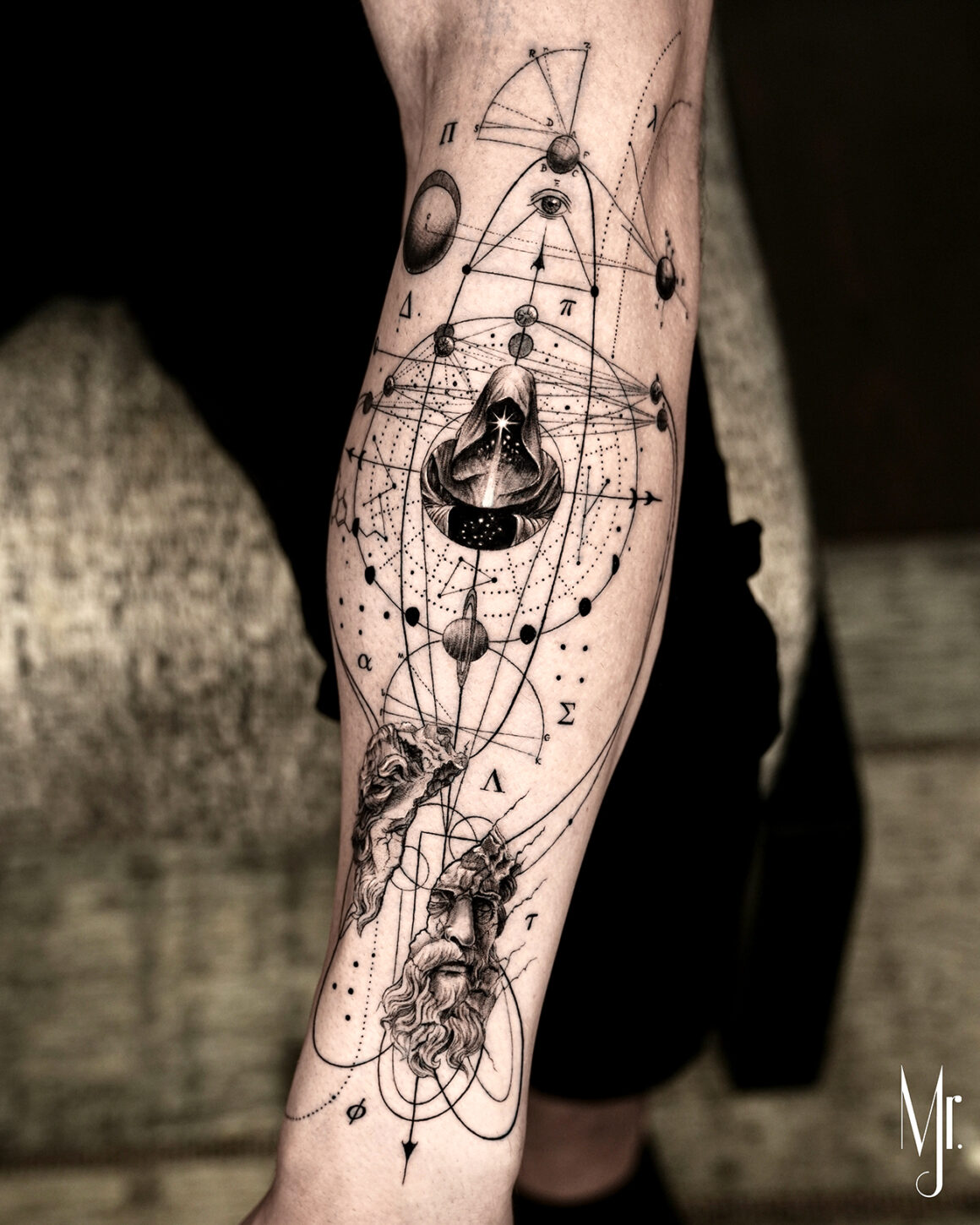
Blackwork Geometric Tattoos
Blackwork geometric tattoos use bold black ink, strong contrast, and high visual impact. They are among the most durable geometric styles because thicker lines generally age better than delicate details.
Many experienced artists recommend blackwork for large projects because it maintains readability over decades.
Advantages include:
- Excellent longevity
- Strong contrast
- High visibility
- Lower risk of detail loss
- Works well on larger body areas
Large-scale sleeves and back pieces frequently incorporate blackwork foundations to anchor complex geometric compositions.
Dotwork Geometric Tattoos
Dotwork geometric tattoos create shading, depth, and texture using thousands of individual dots rather than traditional shading techniques. This approach produces a distinctive handcrafted appearance.
Dotwork is particularly popular in sacred geometry because it enhances visual complexity without overwhelming the design.
Experienced artists carefully control dot density to create gradients and dimensional effects. Poorly executed dotwork can appear muddy or inconsistent after healing.
Expert Tip: Review healed examples when evaluating a dotwork artist’s portfolio. Fresh tattoos often conceal inconsistencies that become visible months later.
Fine Line Geometric Tattoos
Fine-line geometric tattoos emphasize delicate precision and minimalist aesthetics. While visually elegant, they require thoughtful planning because extremely thin lines may soften over time.
Social media has dramatically increased demand for fine-line geometric tattoos, yet many articles fail to discuss longevity concerns.
Key considerations include:
- Artist experience level
- Line spacing
- Body placement
- Sun exposure habits
- Skin type
Areas with frequent movement, stretching, or friction may accelerate detail loss. Designs with adequate spacing generally age more successfully than densely packed fine-line compositions.
Mandala Geometric Tattoos
Mandala tattoos combine geometric precision with symbolic circular patterns representing balance, wholeness, and harmony. They remain one of the most requested geometric tattoo styles globally.
Mandalas can function as standalone tattoos or serve as focal points within larger sleeves and body compositions.
The circular structure naturally complements several placements:
- Shoulders
- Knees
- Elbows
- Chest centerpieces
- Upper back
When designed correctly, mandalas create a striking visual anchor that guides the eye through surrounding geometric elements.
Geometric Animal Tattoos
Geometric animal tattoos merge recognizable wildlife imagery with structured geometric frameworks. They balance symbolism, realism, and abstraction within a single design.
Popular subjects include:
- Wolves
- Lions
- Owls
- Foxes
- Elephants
- Deer
- Bears
Many successful designs divide the composition into contrasting sections, combining realistic details on one side with geometric abstraction on the other.
Information Gain Element: The strongest geometric animal tattoos are not necessarily the most detailed. Designs that preserve negative space and visual breathing room often age significantly better than highly compressed compositions.
Best Geometric Tattoo Placement Ideas
Body placement directly affects the appearance, symmetry, healing, and long-term durability of a geometric tattoo. Choosing the right location is often as important as selecting the design itself.
This is one of the most overlooked aspects of geometric tattoo planning. Certain body areas naturally support symmetry, while others introduce distortion through movement and anatomical curvature.
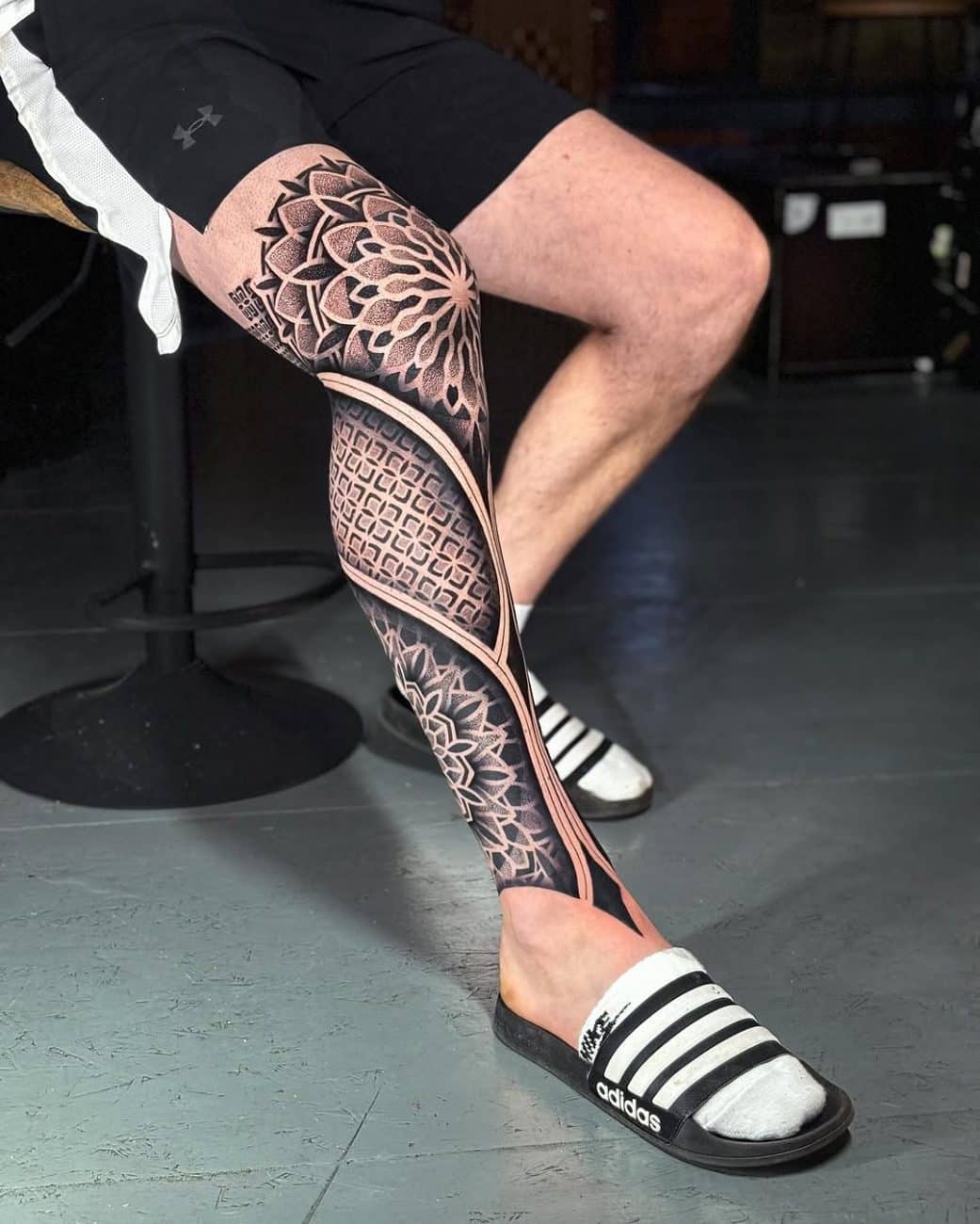
Professional Observation: Experienced geometric tattoo artists often begin placement discussions before finalizing design details because anatomy influences nearly every aspect of composition.
Arm and Sleeve Designs
Arm sleeves provide one of the most versatile canvases for geometric tattoos because they offer sufficient space for pattern flow while remaining highly visible and customizable.
The forearm is particularly popular because relatively flat surfaces help maintain visual alignment.
Benefits of arm placements include:
- Excellent visibility
- Expandable design options
- Strong symmetry potential
- Suitable for beginners and collectors
- Effective showcase for detailed work
Many artists recommend planning future expansion before beginning a sleeve. Piecing together unrelated geometric elements later often creates visual inconsistencies.
Lucky Tattoo, a professional tattoo artist, has over 10 years of experience in the art of tattooing in Ho Chi Minh City. Lucky Tattoo Studio was founded in 2014 by skilled and kind artists. All tattoos are provided in a clean, strictly controlled, and friendly environment.
Leg Sleeve Geometric Tattoos
Leg sleeves offer one of the largest canvases available for geometric tattoo projects, making them ideal for sacred geometry, mandalas, blackwork compositions, and large-scale pattern work that requires uninterrupted visual flow.
The calf and thigh provide expansive surfaces that allow artists to create intricate repeating patterns without excessive compression. Many geometric specialists prefer leg sleeves because they can build cohesive narratives that wrap naturally around the anatomy.
Advantages of geometric leg sleeves include:
- Large uninterrupted design space
- Excellent support for symmetry
- Ideal for sacred geometry layouts
- Reduced UV exposure compared to arms
- Strong long-term readability
One overlooked consideration is muscle movement. Complex geometric designs should be planned around muscle groups to avoid visual distortion when walking, running, or exercising.
Chest and Back Pieces
Chest and back placements provide exceptional symmetry potential, making them among the most effective locations for sacred geometry tattoos, mandalas, and large-scale mathematical compositions.
The body’s centerline naturally supports symmetrical designs such as the Flower of Life, Metatron’s Cube, and large mandalas. These placements also offer enough space for highly detailed work without overcrowding elements.
Many elite tattoo artists reserve the most ambitious geometric projects for the chest and back because these areas allow for cleaner execution and superior visual balance.
Information Gain Insight: Competitor guides often focus on aesthetics but overlook spinal alignment. Successful back tattoos frequently use the spine as a structural anchor, helping preserve visual balance across the entire composition.
Small Geometric Tattoos for Beginners
Small geometric tattoos provide an accessible introduction to the style while minimizing cost, commitment, and healing complexity. Simpler designs also tend to age more predictably than highly detailed miniature compositions.
Popular beginner-friendly options include:
- Triangles
- Minimalist mandalas
- Sacred geometry symbols
- Simple linework patterns
- Geometric mountain designs
- Single-shape compositions
A common mistake is choosing an overly detailed design for a very small area. Fine details may merge over time, reducing clarity and visual impact.
How Much Does a Geometric Tattoo Cost?
Geometric tattoo pricing depends on design complexity, artist expertise, location, session length, and technical difficulty. Because geometric work demands exceptional precision, costs are often higher than many comparable tattoo styles.
While pricing varies globally, clients should focus on artist skill rather than finding the lowest quote. Poor geometric execution can be difficult and expensive to correct.
Factors That Affect Pricing
Several variables determine the final cost of a geometric tattoo, with technical precision often being the most significant factor.
Major pricing influences include:
- Artist reputation
- Design complexity
- Size and placement
- Session count
- Dotwork density
- Sacred geometry intricacy
- Custom design requirements
| Factor | Impact on Cost |
|---|---|
| Custom Design Work | High |
| Large Sleeve Projects | Very High |
| Fine Line Precision | Moderate to High |
| Dotwork Shading | High |
| Artist Experience | Very High |
Highly specialized geometric artists frequently maintain waiting lists due to demand and the time required for proper design planning.
Small vs Large Geometric Tattoo Costs
Small geometric tattoos are generally affordable entry points, while sleeves and large sacred geometry projects represent significant long-term investments requiring multiple sessions.
However, cost should always be evaluated against longevity and execution quality. A poorly executed geometric tattoo may require touch-ups, cover-ups, or laser removal that far exceed the initial savings.
The most expensive geometric tattoo is often the one that needs to be fixed. Precision should always outweigh short-term cost savings.
Do Geometric Tattoos Age Well?
Geometric tattoos can age exceptionally well when designed with proper spacing, line thickness, placement, and technical execution. However, some fine-line designs lose clarity faster than bold geometric compositions.
This topic represents one of the largest information gaps in the tattoo industry. Social media often showcases fresh tattoos while rarely displaying healed examples five or ten years later.
How Line Thickness Affects Longevity
Line thickness plays a critical role in determining how well a geometric tattoo ages. Thicker lines generally maintain definition longer because natural pigment migration affects them less dramatically.
Over time, all tattoos experience slight spreading beneath the skin. When lines are placed too closely together, intricate patterns can become visually compressed.
Professional recommendations include:
- Allow adequate spacing between elements
- Avoid excessive micro-details
- Prioritize readability over complexity
- Consider future skin changes
- Use appropriate line weights
Expert Observation: Many of the best-aging geometric tattoos appear slightly simpler than trending social media designs because longevity was considered during the planning phase.
Body Areas That Preserve Detail Best
Some body areas retain geometric precision more effectively due to lower friction, reduced stretching, and more stable skin conditions.
Generally favorable locations include:
- Outer forearm
- Upper arm
- Calf
- Upper back
- Upper thigh
Areas exposed to frequent friction, repetitive movement, or sun damage may experience accelerated fading and detail loss.
Common Aging Mistakes to Avoid
Many tattoo longevity issues originate during the design stage rather than aftercare. Planning for aging is one of the hallmarks of experienced geometric tattoo specialists.
Common mistakes include:
- Overly dense patterns
- Ultra-thin lines everywhere
- Poor placement selection
- Ignoring future expansion plans
- Choosing inexperienced artists
- Inadequate sun protection
Research from dermatology and tattoo aftercare literature consistently highlights ultraviolet exposure as one of the most significant contributors to tattoo fading.
How to Choose the Right Geometric Tattoo Artist
Choosing the right artist is the single most important decision in a geometric tattoo project. Technical precision, healed results, symmetry consistency, and design planning matter more than social media popularity alone.
Because geometric tattoos expose even minor technical errors, artist selection directly affects both appearance and longevity.
Portfolio Red Flags
A tattoo portfolio reveals far more than artistic style. Careful evaluation can help identify potential technical weaknesses before committing to a permanent design.
Warning signs include:
- Uneven linework
- Inconsistent symmetry
- Lack of healed photos
- Heavy photo editing
- Few large-scale projects
- Limited geometric specialization
Always request healed examples. Fresh tattoos can conceal imperfections that become visible after recovery.
Questions to Ask Before Booking
Asking informed questions helps determine whether an artist understands the unique demands of geometric tattooing.
- How many geometric projects have you completed?
- Can I see healed examples?
- How do you plan large-scale compositions?
- What placement would you recommend?
- How will the design age over time?
- How many sessions should I expect?
Artists who openly discuss limitations, aging considerations, and technical challenges often demonstrate stronger expertise than those making unrealistic promises.
Why Geometry Requires Specialized Skills
Geometric tattooing requires a unique combination of artistic vision, mathematical planning, stencil precision, and technical execution that differs significantly from many other tattoo styles.
Exceptional artists understand:
- Symmetry construction
- Anatomical mapping
- Pattern repetition
- Negative space management
- Long-term readability
- Sacred geometry design principles
This specialization explains why some geometric artists command premium pricing and maintain lengthy waiting lists.
Geometric Tattoo Aftercare and Maintenance
Proper aftercare protects healing skin, preserves line clarity, and reduces the risk of infection, scarring, or premature fading. Geometric tattoos benefit especially from careful maintenance because precision is central to their visual impact.
Aftercare begins immediately after the tattoo session and continues long after the initial healing period.
Healing Timeline Explained
Most geometric tattoos complete surface healing within several weeks, but deeper skin recovery continues for much longer. Understanding realistic healing expectations helps prevent accidental damage.
Typical healing stages include:
- Days 1–3: redness and tenderness
- Days 4–14: peeling and itching
- Weeks 2–4: surface recovery
- Months 1–3: deeper stabilization
Following professional aftercare instructions remains essential throughout the process.
Protecting Fine Details Over Time
Long-term tattoo preservation depends largely on skincare habits, UV protection, and overall skin health. Fine-line geometric tattoos require particular attention.
Best practices include:
- Use broad-spectrum sunscreen
- Maintain skin hydration
- Avoid excessive tanning
- Monitor fading patterns
- Schedule touch-ups when necessary
Many experienced tattoo artists consider sun protection the most effective long-term preservation strategy available.
Real Geometric Tattoo Examples and Design Inspiration
Successful geometric tattoo designs balance visual impact, symbolism, anatomical flow, and long-term readability. The best projects are tailored to both the individual’s goals and the body’s natural structure.
Minimalist Geometric Designs
Minimalist geometric tattoos use simplicity to create elegant, timeless results that often age exceptionally well compared to highly detailed alternatives.
Examples include:
- Single triangles
- Circle compositions
- Linear mountain scenes
- Simple sacred geometry symbols
- Abstract symmetry studies
Sacred Geometry Sleeves
Sacred geometry sleeves combine multiple symbolic entities such as mandalas, the Flower of Life, and Metatron’s Cube into a unified composition.
Successful sleeves prioritize flow, spacing, and hierarchy rather than maximizing detail density.
Modern Abstract Geometry
Modern geometric tattoos increasingly blend traditional geometry with contemporary design influences, creating highly personalized body art.
Popular trends include:
- Blackwork abstraction
- Negative-space compositions
- Architectural geometry
- Nature-inspired mathematics
- Hybrid realism-geometric designs
Expert Tips for Designing a Timeless Geometric Tattoo
Timeless geometric tattoos prioritize balance, readability, personal relevance, and longevity over short-term trends. Designs that age successfully often appear intentional rather than overly complicated.
Balancing Meaning and Aesthetics
The strongest geometric tattoos combine visual appeal with personal significance. Meaning does not need to come solely from traditional symbolism.
Consider:
- Personal milestones
- Mathematical interests
- Spiritual beliefs
- Nature-inspired patterns
- Architectural influences
Avoiding Trend-Driven Regret
Trend-focused designs can lose appeal quickly, while thoughtfully planned geometric tattoos often remain relevant for decades.
Ask yourself:
- Will this design still resonate in ten years?
- Does it reflect my personal story?
- Will the details remain readable over time?
- Is the placement appropriate?
Frequently Asked Questions
What does a geometric tattoo symbolize?
Geometric tattoos commonly represent balance, harmony, interconnectedness, personal growth, spirituality, and the mathematical patterns found throughout nature.
Are geometric tattoos more expensive than traditional tattoos?
Often yes. The precision, planning, symmetry requirements, and specialized skills involved can increase both design and tattooing time.
Do geometric tattoos fade faster?
Not necessarily. Well-executed geometric tattoos with appropriate spacing and line thickness can age extremely well. Fine-line designs generally require more careful planning.
What is the difference between sacred geometry and geometric tattoos?
Sacred geometry tattoos incorporate symbolic mathematical patterns with spiritual or philosophical significance, while geometric tattoos may focus purely on visual design.
Which placement is best for a geometric tattoo?
The forearm, upper arm, calf, upper thigh, chest, and back are often excellent choices because they support symmetry and detail retention.
Can geometric tattoos be combined with other styles?
Yes. Many designs successfully blend geometry with realism, blackwork, dotwork, illustrative elements, animals, and nature-inspired artwork.
How painful is a geometric sleeve tattoo?
Pain varies by placement, session length, and individual tolerance. Large sleeves typically require multiple sessions and longer healing commitments.
Do geometric tattoos age well after ten years?
When designed with longevity in mind and applied by a skilled artist, geometric tattoos can remain visually striking for decades.
Conclusion: Is a Geometric Tattoo Right for You?
A geometric tattoo offers far more than visual appeal. It represents the intersection of mathematics, artistry, symbolism, and technical craftsmanship. Whether you are drawn to sacred geometry, mandalas, blackwork, dotwork, or minimalist compositions, success depends on thoughtful planning, proper placement, realistic longevity considerations, and selecting an artist with proven geometric expertise.
The most impressive geometric tattoos are not always the most complex. They are the designs that balance meaning, anatomy, symmetry, and long-term readability. By understanding how geometric tattoos age, how placement affects performance, and how expert artists approach design, you can make informed decisions that lead to a tattoo that remains powerful and visually compelling for years to come.
Lucky Tattoo, a professional tattoo artist, has over 10 years of experience in the art of tattooing in Ho Chi Minh City. Lucky Tattoo Studio was founded in 2014 by skilled and kind artists. All tattoos are provided in a clean, strictly controlled, and friendly environment.
geometric-tattoo