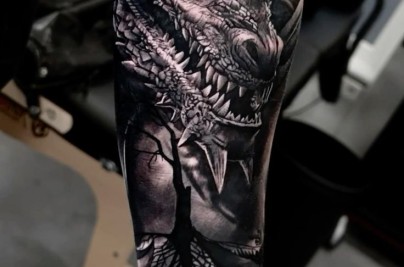
What Are Patchwork Sleeve Ideas?
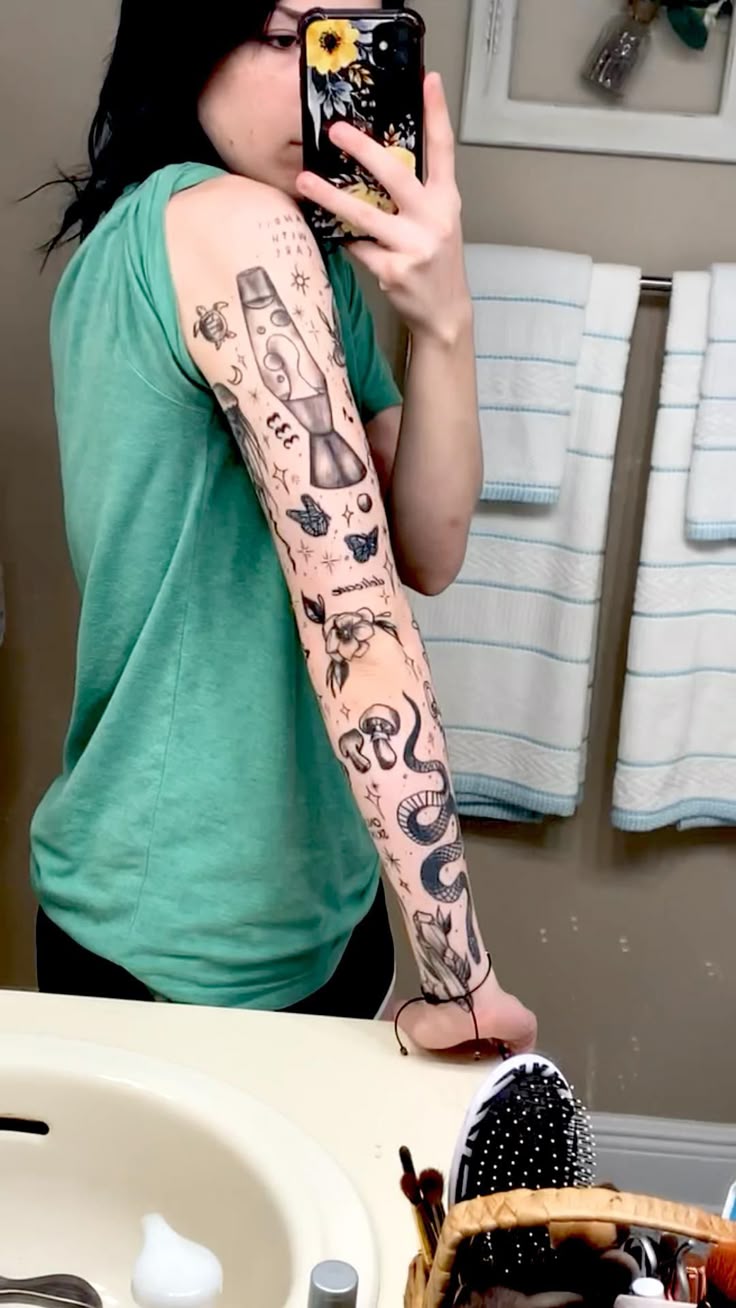
Patchwork sleeve ideas refer to a tattoo design approach where multiple independent tattoos are arranged across the arm to form a cohesive sleeve. Instead of one continuous scene, the design is built through spacing, contrast, and visual balance using different styles, sizes, and meanings that collectively form a curated artistic composition.
From an expert tattoo planning perspective, patchwork sleeves are less about randomness and more about controlled visual storytelling. Each tattoo acts as a standalone “moment,” but the overall sleeve succeeds only when spacing, contrast, and flow are intentionally designed to guide the viewer’s eye along the arm naturally.
A well-executed patchwork sleeve is not a collection of tattoos—it is a structured visual system where each element supports the next through spacing, contrast, and thematic rhythm.
Patchwork vs Full Sleeve Tattoos Explained
Patchwork sleeve tattoos combine separate pieces placed over time, while full sleeve tattoos are designed as one unified composition from shoulder to wrist. Patchwork sleeves offer flexibility and creative freedom, whereas full sleeves prioritize narrative cohesion and pre-planned structure, requiring more upfront design commitment.
From a professional artist’s perspective, patchwork sleeves are ideal for clients who evolve their ideas over time. However, without planning, they risk visual clutter. Full sleeves demand discipline but provide stronger narrative continuity. The choice depends on whether the wearer values adaptability or structured storytelling.
Real Example of Patchwork Composition Strategy
A high-performing patchwork sleeve typically uses a three-layer system: large anchor tattoos (focal points), medium connective pieces, and micro fillers like stars, dots, or florals. This structure prevents visual chaos and creates intentional movement across the arm, even when styles differ significantly.
- Anchor tattoos: Large focal designs like portraits or bold symbols
- Connector tattoos: Medium pieces that balance spacing and flow
- Fillers: Small elements that unify empty spaces
This structure is frequently overlooked in online inspiration boards, where tattoos appear visually appealing individually but lack long-term compositional planning. Professional artists emphasize this layering system to avoid “visual noise” as the sleeve evolves over years.
Best Patchwork Sleeve Ideas by Style
Patchwork sleeve ideas by style focus on combining distinct tattoo genres such as floral, anime, blackwork, and traditional designs into a unified arm composition. The key is not matching styles perfectly but balancing contrast, spacing, and tone so the sleeve feels intentionally curated rather than randomly assembled over time.
Experienced tattoo artists often note that style mixing is where most sleeves fail or succeed. Without a unifying visual logic—such as consistent shading depth or repeated filler motifs—mixed styles can compete instead of complementing each other. Successful patchwork sleeves use controlled contrast rather than visual uniformity.
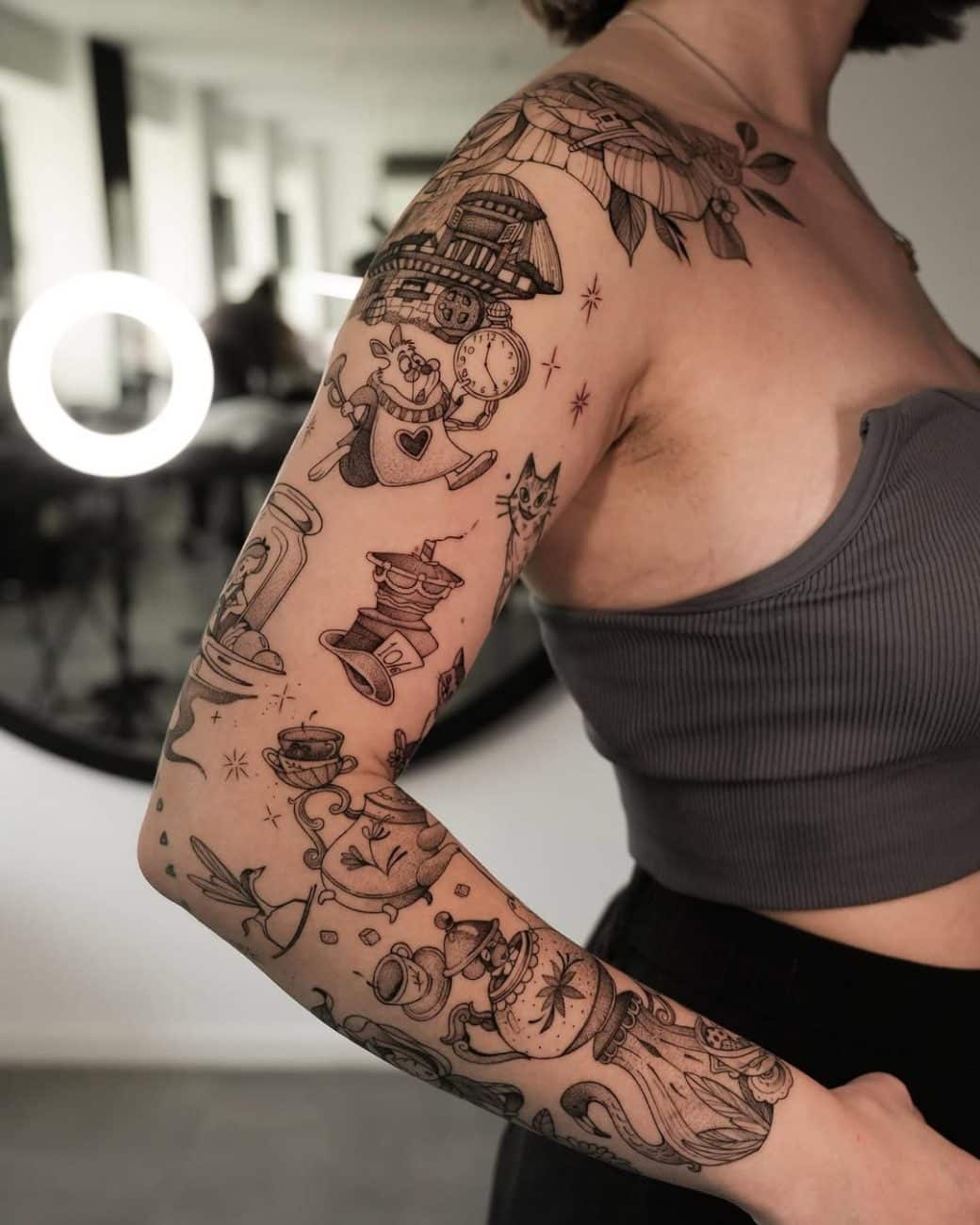
Floral Patchwork Sleeve Ideas
Floral patchwork sleeve ideas combine botanical elements such as roses, peonies, and wildflowers with symbolic or abstract tattoos. This approach works well because floral shapes naturally fill negative space, soften transitions between styles, and add organic flow that enhances overall arm curvature and visual continuity.
Professionally, floral elements are often used as “visual bridges” between unrelated tattoos. However, a common mistake is overusing dense floral clusters, which can flatten contrast. Strategic placement along arm bends creates movement without overwhelming focal tattoos, preserving hierarchy within the sleeve composition.
- Use roses or peonies as mid-sized transition pieces
- Place smaller flowers near joints for natural flow
- Mix linework florals with shaded anchor tattoos for depth
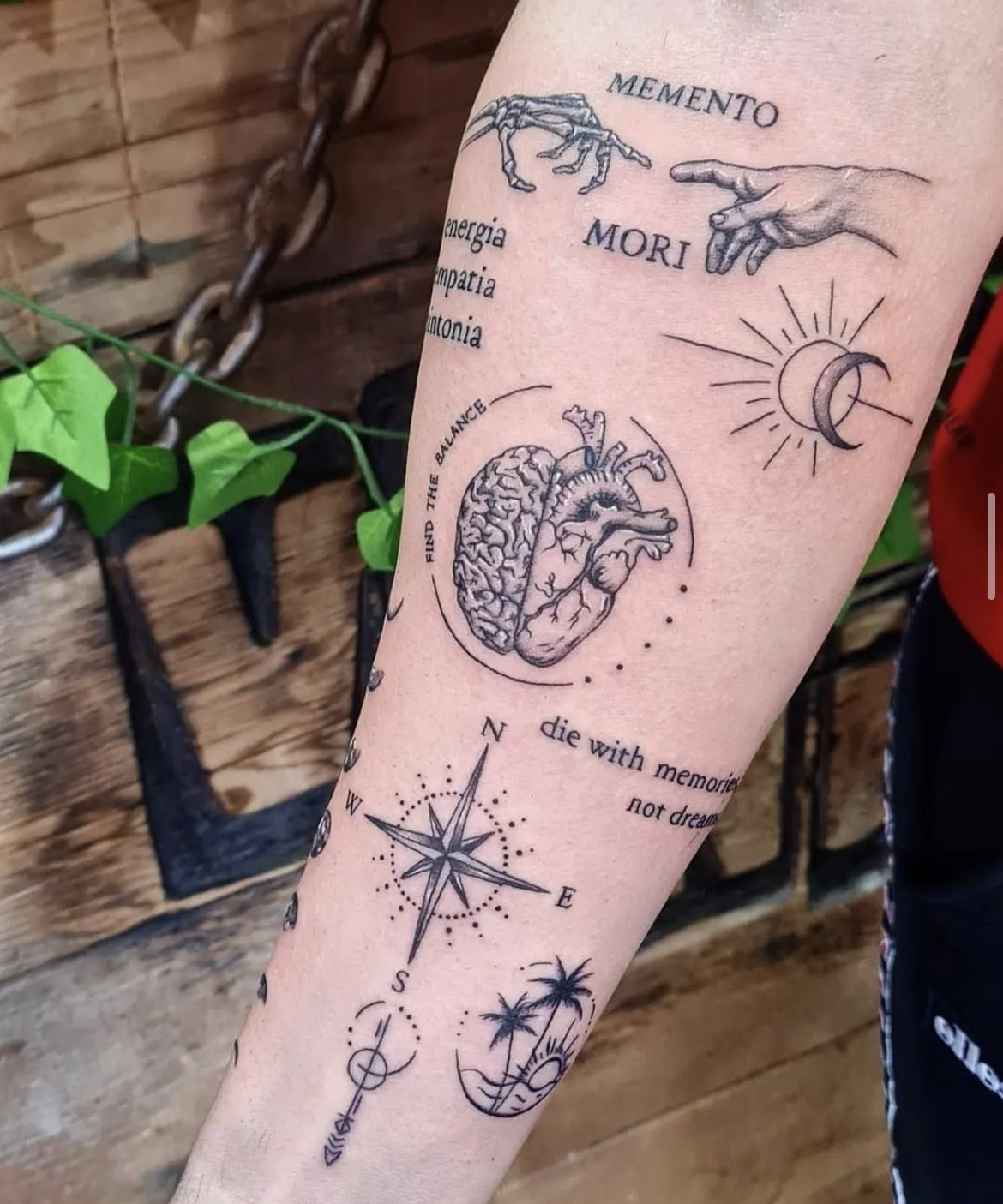
Anime Patchwork Sleeve Ideas
Anime patchwork sleeve ideas combine characters, symbolic scenes, and stylized elements from different series into a cohesive sleeve design. The challenge lies in maintaining visual harmony across varying art styles while ensuring each character retains identity and emotional impact within a shared composition space.
Experts in tattoo composition recommend using consistent shading styles or monochrome palettes to unify anime sleeves. Without this, different character styles can visually clash. Another effective strategy is aligning characters along a narrative flow—such as emotional progression or thematic grouping—to create coherence beyond aesthetics.
Common Mistakes in Anime Patchwork Sleeves
One major oversight is overcrowding multiple main characters without spacing logic. Another is mixing color-heavy designs with blackwork pieces without transitional fillers. Professionals mitigate this by introducing negative space zones and soft gradient fillers that preserve readability across the sleeve.
- Avoid placing too many high-detail characters side by side
- Maintain consistent line thickness or shading style
- Use background motifs like clouds or waves for separation
Black & Grey Patchwork Sleeves
Black and grey patchwork sleeves focus on tonal consistency rather than color harmony, using shading depth, contrast, and texture to unify diverse tattoo elements. This style is highly durable over time and ages more predictably compared to color-heavy sleeves, making it a preferred choice for long-term visual stability.
From a technical perspective, black and grey sleeves rely heavily on gradient control. Without proper contrast variation, tattoos can blur together as they heal and age. Skilled artists often vary ink saturation intentionally across anchor and filler pieces to maintain readability decades after completion.
Expert Insight: Why Black & Grey Ages Better
Industry observation shows that black and grey tattoos maintain structural clarity longer because pigment breakdown is less visually disruptive compared to color fading. This makes them especially suitable for patchwork sleeves where multiple styles must remain distinguishable over time.
- Higher contrast improves long-term readability
- Less color fading reduces visual distortion risk
- Works well with mixed tattoo styles
Lucky Tattoo, a professional tattoo artist, has over 10 years of experience in the art of tattooing in Ho Chi Minh City. Lucky Tattoo Studio was founded in 2014 by skilled and kind artists. All tattoos are provided in a clean, strictly controlled, and friendly environment.
How to Design a Cohesive Patchwork Sleeve
A cohesive patchwork sleeve is created by strategically balancing anchor tattoos, filler elements, and negative space across the arm. Instead of randomly placing tattoos, professionals design visual hierarchy, spacing rhythm, and contrast flow so each piece contributes to a unified composition that still preserves individuality and long-term readability.
Experienced tattoo artists emphasize that cohesion is not about matching styles but controlling visual tension. The most successful sleeves use repetition of shapes, consistent shading logic, and intentional gaps to guide the eye naturally from shoulder to wrist, preventing clutter while preserving creative diversity across different tattoo pieces.
Anchor Tattoo Placement Strategy
Anchor tattoo placement is the structural foundation of a patchwork sleeve, where large, high-impact designs establish visual hierarchy. These anchors define the sleeve’s rhythm and act as focal points that smaller tattoos orbit around, ensuring the composition feels intentional rather than fragmented or visually chaotic.
Professionally, anchors are placed on naturally prominent arm zones such as the outer bicep, forearm center, or shoulder cap. These areas maximize visibility and provide balance. Without anchors, patchwork sleeves often appear disorganized, especially after multiple sessions over time.
Expert Insight: Visual Weight Distribution
One overlooked principle in sleeve design is visual weight distribution. Large tattoos placed too close together create compression, while uneven spacing creates “dead zones.” Skilled artists map the arm like a 3D canvas, ensuring balance from multiple viewing angles, not just frontal perspective.
- Place largest tattoos on outer arm planes
- Balance heavy designs with lighter filler zones
- Avoid clustering multiple focal points in one region
Using Filler Tattoos Correctly
Filler tattoos are small design elements used to connect larger tattoos and maintain visual flow. They include dots, stars, geometric patterns, smoke, or floral fragments. When used correctly, fillers prevent empty gaps from feeling unfinished while preserving breathing space within the overall sleeve composition.
However, excessive filler use is a common mistake. Overfilling reduces contrast and turns a patchwork sleeve into visual noise. Professional artists carefully scale filler density based on surrounding tattoo complexity, ensuring balance rather than overcrowding.
Common Filler Mistakes to Avoid
The most frequent issue is uniform filler distribution, which flattens visual hierarchy. Another mistake is using overly detailed fillers that compete with anchor tattoos. Instead, fillers should remain subtle, supporting—not dominating—the composition.
- Avoid repeating the same filler pattern everywhere
- Do not overload small spaces with high-detail fillers
- Maintain contrast between fillers and anchor tattoos
Patchwork Sleeve Planning Step-by-Step
Planning a patchwork sleeve involves gradually building a structured visual system rather than collecting random tattoos. The process includes theme selection, placement mapping, and long-term spacing strategy to ensure each tattoo contributes to a cohesive arm composition that evolves intentionally over time.
Professional studios often treat sleeves as evolving projects rather than single-session artworks. This allows flexibility while preserving design integrity. Without planning, sleeves tend to lose balance as new tattoos are added without spatial or stylistic coordination.
Choosing Themes and Styles
Choosing themes and styles for a patchwork sleeve involves aligning personal meaning with visual compatibility. Instead of forcing identical styles, experts recommend selecting complementary themes such as nature, mythology, or cultural symbolism that can coexist through shared visual tone or contrast control.
A major misconception is that all tattoos must match stylistically. In reality, cohesion is achieved through structured contrast, not uniformity. A floral tattoo can coexist with a geometric or anime piece if spacing, shading, and visual weight are managed correctly.
Information Gain: Hybrid Aesthetic Strategy
Professional tattoo designers often use a hybrid aesthetic strategy where unrelated styles are unified through consistent shading depth or recurring micro-motifs. This approach is rarely discussed in consumer-level guides but is widely used in high-end sleeve compositions.
- Define 2–3 core themes before starting
- Allow controlled style variation within structure
- Use recurring visual motifs for cohesion
Working With a Tattoo Artist
Working effectively with a tattoo artist is critical for building a successful patchwork sleeve. Collaboration ensures that each new tattoo fits into the evolving composition rather than disrupting it. Professional artists evaluate spacing, flow, and long-term expansion potential before placing any new design.
Clients who treat sleeves as collaborative projects achieve more cohesive results than those who request isolated tattoos. Artists often adjust placement plans dynamically based on existing ink, skin curvature, and future expansion zones.
Cost, Pain, and Time Expectations
Patchwork sleeves require multiple sessions over months or years, with cost, pain, and time varying based on size, style complexity, and artist expertise. Unlike full sleeves, patchwork designs evolve gradually, making budgeting and scheduling more flexible but also harder to predict without professional planning guidance.
From an industry perspective, sleeves are long-term investments in both time and physical endurance. Proper expectations prevent frustration, especially when sessions are spaced out to allow skin healing and design refinement between tattoos.
How Many Sessions Are Needed
The number of sessions required for a patchwork sleeve depends on tattoo size, density, and stylistic complexity. Most sleeves require 5 to 15 sessions, sometimes more if detailed realism or color work is involved. Healing time between sessions also affects overall completion timelines.
Experienced artists recommend spacing sessions strategically to avoid overworking the skin. Rushing placement leads to poor healing outcomes and reduced visual clarity in densely packed areas.
- Small tattoos: 1–2 sessions each
- Medium anchor pieces: 2–4 sessions
- Full sleeve completion: 6–18 months average
Pain Levels for Patchwork Sleeves
Pain levels vary significantly depending on arm location, skin sensitivity, and session duration. Areas near bone such as the elbow, wrist, and inner bicep tend to be more painful due to lower fat coverage and higher nerve density.
However, patchwork sleeves distribute pain over time, making the overall experience more manageable compared to full-sleeve marathon sessions. Many clients find this staggered approach physically easier and psychologically less intense.
Medical Insight: Skin Sensitivity Variation
Dermatological research shows that repeated tattooing in the same area may slightly reduce sensitivity due to localized nerve adaptation. However, pain perception remains subjective and influenced by stress, hydration, and sleep quality.
- Outer arm areas are generally less painful
- Inner elbow and wrist are more sensitive
- Fatigue increases pain perception significantly
Common Mistakes in Patchwork Sleeves
Common mistakes in patchwork sleeves include overcrowding, inconsistent style blending, and lack of spatial planning. These issues often arise when tattoos are added impulsively without considering long-term composition, leading to visual imbalance and reduced aesthetic coherence over time.
Professional artists frequently correct sleeves that suffer from “visual fragmentation,” where individual tattoos are strong but fail to function as a unified design. Proper planning prevents these issues early in the process.
Overcrowding the Arm
Overcrowding occurs when too many tattoos are placed too closely without sufficient negative space. This reduces clarity, flattens visual hierarchy, and makes individual tattoos harder to distinguish, especially after healing and ink settling over time.
Negative space is not empty—it is an active design element that enhances readability and contrast within the sleeve composition.
Mixing Incompatible Styles
Mixing incompatible tattoo styles without visual unification strategies leads to aesthetic conflict. For example, ultra-realistic portraits may clash with bold cartoon-style tattoos unless balanced through consistent shading or transitional filler elements.
Skilled artists mitigate this by introducing unifying visual cues such as consistent line weight or shared background textures.
Patchwork Sleeve Maintenance & Aftercare
Patchwork sleeve maintenance involves proper aftercare, hygiene, and long-term skin health management to ensure tattoos heal correctly and retain visual clarity. Because sleeves develop over multiple sessions, consistent aftercare practices are essential for maintaining uniform healing across all tattoo elements.
Health authorities such as the CDC and NHS emphasize infection prevention through proper cleaning, moisturizing, and avoiding sun exposure during healing stages. Long-term care also plays a key role in preventing ink fading and skin irritation.
- Keep tattoos clean and moisturized during healing
- Avoid direct sunlight for at least 2–3 weeks per session
- Follow artist-specific aftercare instructions strictly
Healing Timeline Explained
The tattoo healing process typically occurs in stages: initial healing (1–2 weeks), surface recovery (3–4 weeks), and deep skin stabilization (up to 3 months). Each stage affects how ink settles, which is especially important for patchwork sleeves built over long periods.
Improper healing between sessions can impact overall sleeve consistency, making timing and care essential for professional-quality results.
Frequently Asked Questions (FAQ)
What is a patchwork sleeve tattoo?
A patchwork sleeve tattoo is a collection of individual tattoos arranged on the arm in a cohesive layout using spacing, fillers, and visual balance rather than a single continuous design.
Do patchwork sleeves look good over time?
Yes, when properly planned with anchors and spacing, patchwork sleeves age well and maintain clarity, especially when using consistent shading styles and balanced composition.
How do you make a patchwork sleeve cohesive?
Cohesion is achieved through anchor tattoos, filler elements, negative space, and consistent visual flow that guides the eye across the arm naturally.
Can you mix different tattoo styles?
Yes, different styles can be mixed if balanced with consistent shading, spacing, and visual hierarchy to prevent stylistic conflict.
How long does a patchwork sleeve take?
Most patchwork sleeves take 6 to 18 months depending on size, complexity, and healing time between sessions.
Are patchwork sleeves more painful than full sleeves?
No, they are often less painful because sessions are spaced out, allowing recovery time between tattoos.
What are the best fillers for patchwork tattoos?
Common fillers include dots, stars, smoke, geometric shapes, and floral elements that help unify empty spaces without overcrowding the design.
Conclusion: Building a Sleeve With Intentional Design
Patchwork sleeve ideas succeed when treated as structured visual systems rather than random collections of tattoos. By combining anchors, fillers, spacing strategy, and stylistic balance, the sleeve becomes a curated artistic composition that evolves meaningfully over time while maintaining clarity and aesthetic harmony.
Lucky Tattoo, a professional tattoo artist, has over 10 years of experience in the art of tattooing in Ho Chi Minh City. Lucky Tattoo Studio was founded in 2014 by skilled and kind artists. All tattoos are provided in a clean, strictly controlled, and friendly environment.
patchwork-sleeve-ideas