What Is a Chest Piece Tattoo?
A chest piece tattoo is a large-scale body art composition that covers the upper torso, typically spanning both pectoral muscles, the sternum, and sometimes extending to the shoulders or upper abdomen. It is designed as a unified visual system rather than isolated elements, requiring careful planning of anatomy flow, symmetry, and long-term skin movement to maintain clarity over time.
From an experienced tattoo composition standpoint, chest pieces are considered “architectural tattoos” because they must adapt to curved muscle structures and shifting body posture. Unlike smaller tattoos, they are designed with long-term visibility, aging behavior, and body dynamics in mind.
Chest Anatomy and Placement Zones
A chest tattoo is shaped directly by anatomical structure, including the pectoral muscles, sternum ridge, and clavicle lines. These areas influence how ink sits, stretches, and visually flows over time. Proper placement ensures the design remains balanced even when the body is in motion or changes with muscle growth or weight fluctuations.
- Pectorals: Best for symmetrical focal designs and portraits
- Sternum: High-detail central axis, but highest pain sensitivity
- Upper chest/clavicle: Ideal for framing elements and flow extension
Common Misconception: Chest Tattoos Stay Visually Static
One of the most overlooked truths is that chest tattoos are not static artworks. Skin elasticity, breathing movement, and muscle expansion subtly alter alignment over time. Experienced artists anticipate these shifts by adjusting stencil angles and spacing to ensure long-term visual stability rather than short-term perfection.
Best Chest Piece Tattoo Styles
Chest piece tattoo styles vary significantly in execution, longevity, and visual impact. The most successful designs are those that align body symmetry with stylistic structure, ensuring the artwork complements natural anatomical flow rather than fighting against it. Choosing the right style determines both aesthetic success and long-term aging performance.
Neo-Traditional Chest Tattoos
Neo-traditional chest tattoos combine bold outlines, layered shading, and stylized realism to create high-impact designs that age exceptionally well. This style is favored for chest placements because its structural boldness resists fading distortion, while its flexible composition allows adaptation to muscular curvature.
Artists often use neo-traditional techniques to build “visual hierarchy,” placing dominant focal points at the center of the sternum and secondary elements along the pectorals. This ensures that the viewer’s eye naturally follows the anatomy rather than flattening the design.
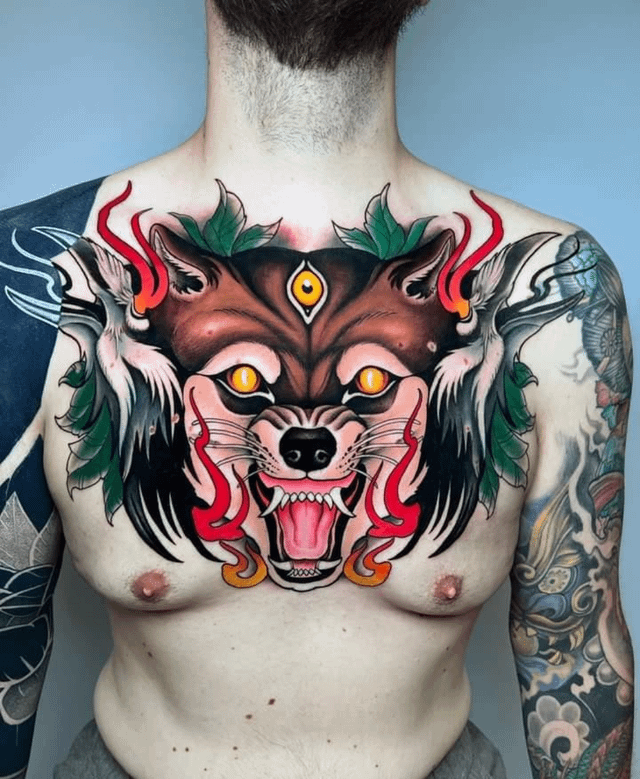
Expert Insight: Neo-traditional chest pieces outperform fine-line designs in longevity because thicker outlines resist ink dispersion caused by dermal regeneration cycles. This makes them a strategic choice for clients prioritizing aging stability over delicate minimalism.
Japanese Irezumi Chest Panels
Japanese chest tattoos, often referred to as irezumi-style compositions, are built on flowing body integration rather than isolated imagery. These designs typically extend across the chest and ribs in continuous motion, using wind, waves, or mythological elements to unify the torso into a single narrative field.
From a technical standpoint, irezumi requires precise body mapping. Artists must account for rib curvature and breathing expansion to maintain flow continuity, making this one of the most anatomically complex tattoo styles.
Blackwork & Geometric Chest Designs
Blackwork chest tattoos rely on high contrast, negative space control, and geometric symmetry to produce bold visual statements. These designs are particularly effective for clients seeking strong identity expression without color dependency. However, precision alignment is critical, as asymmetry becomes highly noticeable on the chest plane.
Real-world observation: Blackwork designs often age better in low-maintenance lifestyles, especially for clients with high sun exposure, as dense pigment blocks resist fading more effectively than gradient-heavy tattoos.
Chest Tattoo Pain Level Explained
Chest tattoos are widely recognized as one of the most painful tattoo placements due to thin skin coverage, direct bone proximity, and high nerve density around the sternum and collarbone. Pain intensity varies significantly between individuals, but the sternum consistently ranks among the highest sensitivity zones in tattooing.
Why the Sternum Hurts More
The sternum area produces higher pain levels because it has minimal fat or muscle cushioning between skin and bone, causing needle vibrations to transmit directly into bone structure. Additionally, nerve concentration in this region amplifies sensation, especially during shading or repeated passes over the same area.
Professional recommendation: Experienced artists often schedule sternum work in shorter sessions to manage client fatigue and reduce involuntary body tension, which can affect ink consistency.
Common Misconception: Pain Is the Same for Everyone
Pain perception is highly variable and influenced by psychological state, sleep quality, hydration, and stress levels. Two clients receiving identical sternum work may report completely different experiences. Over time, many clients also develop “pain adaptation,” where sensitivity decreases after the first major session.
Chest Tattoo Cost and Time Commitment
Chest piece tattoos are long-term artistic investments that require multiple sessions, strategic budgeting, and collaboration between artist and client. Cost is not determined solely by size, but by complexity, shading density, stylistic precision, and artist expertise level. Time commitment often extends across weeks or months depending on healing cycles and design refinement stages.
Most chest pieces are structured as multi-session projects because skin needs recovery time between intensive shading or linework sessions. Rushing the process can compromise ink saturation, symmetry accuracy, and long-term visual clarity.
Chest Tattoo Healing Process and Aftercare
Lucky Tattoo, a professional tattoo artist, has over 10 years of experience in the art of tattooing in Ho Chi Minh City. Lucky Tattoo Studio was founded in 2014 by skilled and kind artists. All tattoos are provided in a clean, strictly controlled, and friendly environment.
Healing is not just surface-level recovery; it involves ink stabilization within the dermis layer. Improper care during this phase can lead to patchy fading, infection risk, or uneven texture that permanently affects the final appearance.
Aftercare Best Practices for Chest Tattoos
Effective chest tattoo aftercare focuses on protecting the skin barrier, minimizing bacterial exposure, and maintaining optimal moisture balance. The chest is exposed to constant movement and sweat, so aftercare routines must be more disciplined than for less mobile body areas.
- Clean gently: Use fragrance-free antibacterial soap twice daily
- Moisturize lightly: Apply thin layers of tattoo-safe ointment
- Avoid friction: Wear loose, breathable clothing
- No sun exposure: UV rays significantly degrade fresh ink
Expert Insight: Dermatology observations show that over-moisturizing is one of the most common mistakes, creating a suffocating layer that slows epidermal recovery and increases breakout risk.
Common Healing Mistakes and Risk Factors
Many chest tattoo complications arise from preventable aftercare errors rather than artist technique. The chest is especially vulnerable due to sweat accumulation and constant fabric contact, which increases infection probability if hygiene is inconsistent.
- Picking or scratching scabs prematurely
- Sleeping directly on the fresh tattoo
- Exposing healing skin to direct sunlight
- Using petroleum-heavy products excessively
Real-world scenario: Clients who return to intense physical training too early often experience ink blurring along the sternum due to repeated stretching before full dermal stabilization occurs.
Best Chest Piece Tattoo Ideas (Men & Women)
Chest tattoo ideas vary widely based on symmetry preferences, identity expression, and anatomical flow. The most effective designs integrate body structure with visual storytelling, ensuring the artwork enhances natural chest shape rather than overpowering it. Successful designs consider long-term aging and personal symbolism equally.
Chest pieces are not just decorative; they function as identity anchors that reflect personal narratives, beliefs, or aesthetic direction.
Symmetrical Chest Designs
Symmetrical chest tattoos are built around a central axis—usually the sternum—creating mirrored compositions across both pectorals. This approach enhances visual balance and makes the chest appear structurally unified. It is one of the most technically demanding design approaches due to precise alignment requirements.
Artists often use geometric scaffolding techniques or stencil mapping to ensure both sides remain perfectly proportioned even when the body is in motion.
Information Gain Insight: Symmetry is not just visual—it influences psychological perception of strength, stability, and confidence, which is why symmetrical chest tattoos are frequently chosen for identity reinforcement.
Feminine Chest Tattoo Concepts
Feminine chest tattoos often emphasize flow, curvature, and delicate structural balance, with designs such as floral sternum pieces, ornamental mandalas, or minimal linework compositions. Placement is typically centered along the sternum or subtly extended across the upper chest for elegance rather than dominance.
Designers often adapt motifs to follow natural collarbone curvature, ensuring harmony between anatomy and artistic flow rather than rigid symmetry.
Chest Tattoo Longevity and Aging
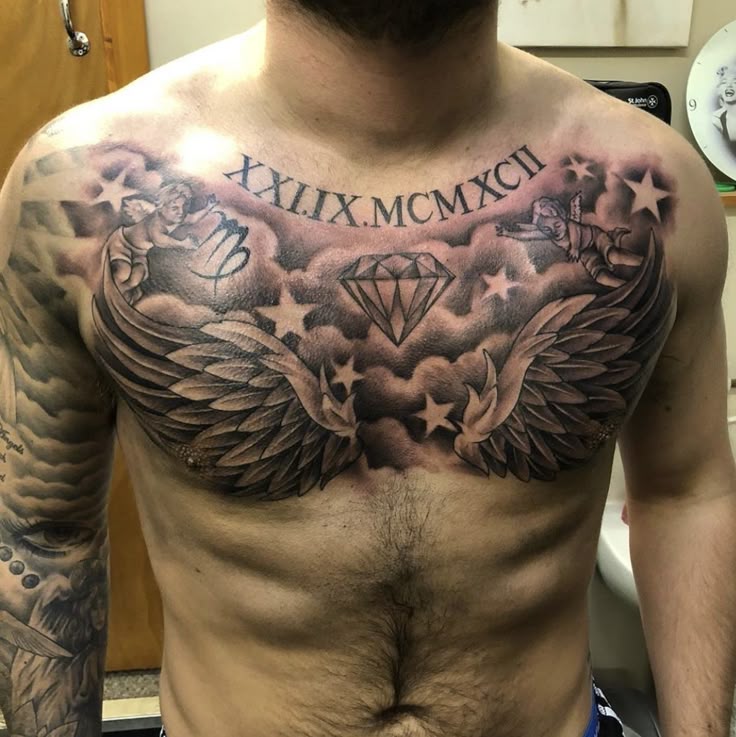
Chest tattoo longevity depends on ink quality, placement precision, sun exposure, and skin elasticity changes over time. Unlike flat surfaces, the chest undergoes constant movement from breathing and posture shifts, which gradually influences how ink disperses and how lines soften over years.
Understanding aging behavior is critical for selecting styles that maintain clarity and avoid premature distortion or fading.
How Chest Tattoos Change Over Time
Chest tattoos naturally evolve as skin regenerates and collagen structure changes with age. Areas near the sternum may show slight spreading of ink over years, while outer pectoral regions tend to maintain sharper edges. Sun exposure is one of the most significant accelerators of fading.
Expert observation: Tattoos with bold outlines and dense shading maintain structural integrity significantly longer than fine-line or ultra-detailed micro designs on the chest.
Common Misconception: Tattoos Stay Identical Forever
A widespread misconception is that tattoos remain unchanged after healing. In reality, dermal ink stabilizes but continues to interact with biological processes. Over a 10–20 year period, subtle softening is expected, especially in high-movement areas like the chest.
Choosing the Right Tattoo Artist for Chest Pieces
Choosing the right tattoo artist for a chest piece is one of the most critical decisions in the entire process. Chest tattoos require advanced anatomical understanding, composition planning, and technical shading control. A skilled artist does not just apply ink—they design how the tattoo interacts with your body long-term.
Portfolio review should focus on healed work, symmetry execution, and consistency across large-scale pieces rather than small flash tattoos.
What to Look for in a Chest Tattoo Specialist
A qualified chest tattoo artist demonstrates strong experience in large-scale body composition, precise symmetry alignment, and advanced shading techniques. They should also show evidence of healed chest or torso work, not just fresh tattoos.
- Strong portfolio of chest or torso projects
- Consistent linework under curved anatomy
- Understanding of body flow and symmetry
- Clear communication about healing expectations
Information Gain Insight: Many high-level tattoo artists plan chest pieces like “visual architecture,” mapping focal points before drawing any stencil to ensure long-term anatomical harmony rather than short-term aesthetics.
Frequently Asked Questions (FAQ)
How long does a chest tattoo take to heal completely?
A chest tattoo typically heals on the surface within 2–4 weeks, but full dermal recovery can take up to 2–3 months depending on size, aftercare quality, and individual skin regeneration speed.
Is a chest tattoo more painful than other body areas?
Yes, chest tattoos—especially over the sternum and collarbone—are considered high pain areas due to thin skin and direct bone proximity, making them more intense than arms or thighs.
What tattoo styles last longest on the chest?
Bold styles such as neo-traditional, blackwork, and Japanese irezumi tend to age better because their strong linework and shading resist long-term fading and distortion.
Can chest tattoos affect future body changes like muscle gain?
Yes, significant muscle growth or weight fluctuation can subtly alter tattoo proportions over time, especially in areas near the pectoral muscles and sternum.
How should I prepare before getting a chest tattoo?
Stay hydrated, avoid alcohol and blood-thinning substances, get adequate sleep, and eat a proper meal before the session to improve pain tolerance and skin response.
Are chest tattoos safe for all skin types?
Most skin types can safely receive chest tattoos, but individuals with sensitive skin or dermatological conditions should consult a professional dermatologist beforehand.
Final Thoughts on Chest Piece Tattoos
Chest piece tattoos represent one of the most advanced forms of body art due to their anatomical complexity, emotional significance, and long-term visibility. A well-designed chest tattoo integrates artistry with biology, ensuring that the design evolves gracefully with the body rather than against it.
Choosing the right style, artist, and aftercare strategy is essential for achieving a result that remains visually strong and personally meaningful for decades.