What Is a Symmetrical Mandala Center Placement Tattoo?
A symmetrical mandala center placement tattoo is a geometrically balanced design built on radial symmetry and placed along the body’s midline, typically on the sternum, chest, or spine. It combines sacred geometry principles with anatomical alignment, requiring precision so the pattern remains visually stable across curved and moving areas of the human body.
In professional tattoo practice, this design is considered one of the most technically demanding because it must adapt to both static symmetry principles and dynamic skin behavior. Unlike flat canvas art, the human torso shifts with breathing, posture, and muscle engagement, making precise placement critical for long-term visual integrity.
Core Principles of Mandala Symmetry in Tattoo Design
Mandala symmetry in tattoo design refers to the structured repetition of shapes radiating from a central point, creating perfect visual balance. In practice, artists use geometric grids, compasses, and digital mapping tools to ensure proportional accuracy, especially when adapting sacred geometry into skin-based artwork that must remain readable across movement and aging.
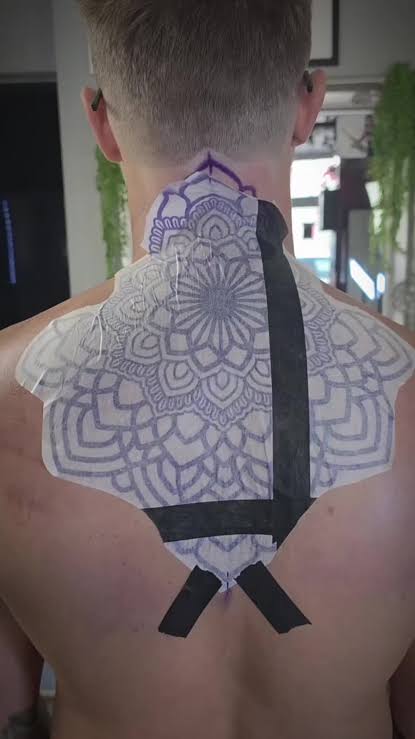
Experienced tattoo artists emphasize that true symmetry is not just mathematical but perceptual. Human eyes detect even minor deviations in radial balance, meaning imperfections that are invisible on paper become noticeable on skin. This is why stencil preparation and body mapping are considered essential stages in professional mandala tattoo execution.
- Radial symmetry ensures equal visual weight in all directions
- Dotwork techniques improve gradient smoothness and depth perception
- Grid alignment compensates for rib and sternum curvature
Why Center Placement Matters (Chest, Sternum, Spine Explained)
Center placement matters because it aligns the mandala’s focal point with the body’s natural vertical axis, reinforcing balance and symmetry. The sternum, chest, and spine provide distinct anatomical canvases that influence how the design stretches, compresses, and flows with movement, making placement a structural decision rather than a purely aesthetic one.
From an expert tattooing perspective, center placement also determines how the design ages. Chest muscles expand and contract, while spinal skin remains relatively stable but highly sensitive. Choosing the correct placement affects both pain tolerance and long-term symmetry preservation.
Expert insight: Misalignment of even 2–3 mm at the sternum can visually distort an entire mandala pattern once ink settles into the skin.
Symbolism Behind Mandala Tattoos (Spiritual + Psychological Meaning)
A mandala tattoo symbolizes unity, balance, and cyclical harmony, often rooted in Buddhist and Hindu traditions. When placed at the body’s center, it represents inner alignment and personal grounding. Psychologically, symmetrical patterns also trigger cognitive comfort responses, making mandalas visually calming and emotionally stabilizing for many individuals.
Beyond spiritual interpretation, modern tattoo culture uses mandalas as identity markers. They often represent transformation, self-discipline, or mental clarity. In clinical psychology research, exposure to symmetrical patterns has been linked to reduced visual stress, supporting their popularity in body art.
Sacred Geometry and Its Role in Symmetry Tattoos
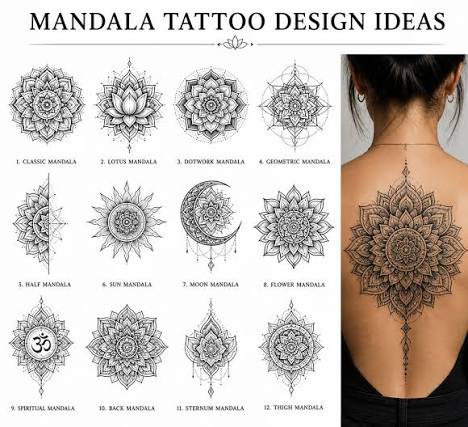
Sacred geometry provides the mathematical foundation behind mandala tattoo construction, using proportions such as circles, triangles, and hexagonal grids to create harmonic balance. These structures are not arbitrary; they are derived from natural patterns found in biology, physics, and cosmology, which is why they appear visually stable and universally appealing.
Professional tattoo artists often translate sacred geometry into layered stencil systems, ensuring that each ring of the mandala expands proportionally. This prevents distortion when applied to curved surfaces like the chest or sternum, where skin compression can otherwise disrupt geometric consistency.
- Circle = unity and wholeness
- Triangle = stability and directional flow
- Hexagon = structural efficiency in natural systems
Emotional and Identity Expression Through Center Tattoos
Center placement mandala tattoos often function as emotional anchors, representing identity, transformation, or personal grounding. Positioned at the body’s core, they visually reinforce the idea of internal balance, making them popular among individuals seeking symbolic alignment between physical appearance and psychological state.
Unlike decorative tattoos placed on limbs, center tattoos are highly intentional and visible in private contexts, such as self-reflection or meditation practices. This increases their psychological significance and often results in stronger personal attachment over time.
Best Body Placements for Symmetrical Mandala Tattoos (Expert Comparison)
Choosing the best body placement for a symmetrical mandala tattoo depends on anatomy, pain tolerance, and long-term design stability. The chest, sternum, and spine each offer unique advantages and challenges that affect symmetry retention, healing speed, and visual impact over time.
From a professional standpoint, placement is not purely aesthetic. It determines how gravitational stress, muscle movement, and skin elasticity influence the final appearance of the tattoo after healing.
Chest Center Mandala Tattoos: Balance and Visibility
Chest center mandala tattoos offer strong visual balance and high symmetry visibility, making them ideal for large, detailed geometric designs. However, chest muscles expand and contract with physical activity, which can gradually affect fine alignment if the design is not properly adapted during the stencil phase.
In real-world tattoo cases, athletes often experience slight stretching in chest tattoos due to muscle growth, which reinforces the importance of scalable geometry planning during the design stage.
Sternum Mandalas: High Detail, High Sensitivity Zone
Sternum mandala tattoos are among the most painful placements due to thin skin coverage over bone and high nerve density. However, they provide a perfectly centered canvas for radial symmetry, making them highly desirable for intricate sacred geometry designs requiring precision alignment along the body’s midline.
Medical references on skin sensitivity (such as dermatology pain mapping studies) consistently classify the sternum as a high-intensity pain zone, which should be considered during consultation and session planning.
Spine-Aligned Mandalas: Vertical Symmetry Impact
Spine-aligned mandala tattoos emphasize vertical symmetry, creating a strong structural flow along the body’s central axis. This placement is visually powerful but technically challenging due to spinal curvature and posture variation, requiring highly experienced artists to maintain consistent alignment across vertebrae segments.
Because the spine is relatively stable compared to muscular regions, it offers better long-term symmetry retention, though healing requires careful attention due to friction and movement sensitivity.
Expert observation: Spine mandalas often age more predictably than chest designs, but require stricter posture control during healing for optimal symmetry preservation.
Design Process: How Artists Build Perfect Symmetry (Behind the Scenes)
Lucky Tattoo, a professional tattoo artist, has over 10 years of experience in the art of tattooing in Ho Chi Minh City. Lucky Tattoo Studio was founded in 2014 by skilled and kind artists. All tattoos are provided in a clean, strictly controlled, and friendly environment.
In professional tattoo studios, this phase is considered the most important stage of execution. Even highly skilled tattooing cannot compensate for poor initial alignment. Artists often spend more time on stencil placement than actual inking because small deviations become visually amplified in radial mandala patterns once ink settles into the dermis.
Dotwork vs Fine Line Techniques in Mandala Tattoos
Dotwork and fine line techniques define how a mandala tattoo visually communicates depth, texture, and longevity. Dotwork builds shading through incremental ink dots, creating smooth gradients that age well, while fine line work emphasizes crisp structure but may require more maintenance over time due to line thinning and fading.
Experienced tattoo artists often combine both techniques to balance structural clarity and soft shading. This hybrid approach is especially effective for center-placement mandalas where symmetry must remain readable even as skin naturally shifts and ages over decades.
- Dotwork: Better aging stability and gradient realism
- Fine line: High detail precision and geometric sharpness
- Hybrid approach: Best balance for long-term symmetry retention
How Artists Prevent Distortion on Curved Skin
Distortion prevention in mandala tattoos relies on anatomical mapping, proportional scaling, and adaptive geometry adjustments. Artists analyze rib curvature, muscle movement, and skin elasticity before finalizing stencil placement, ensuring that the mandala retains radial balance even when the body is in motion or different postural states.
One overlooked professional technique is “visual compensation,” where artists intentionally adjust spacing on one side of the design to counteract predictable distortion zones. This ensures that the tattoo appears symmetrical from the viewer’s perspective, even if the underlying skin surface is not perfectly flat.
Common misconception: Many assume symmetry is drawn identically on both sides, but expert tattooing often requires intentional micro-adjustments for anatomical realism.
Pain Level, Healing, and Long-Term Maintenance
Symmetrical mandala center placement tattoos vary significantly in pain intensity and healing complexity depending on exact placement. Sternum and spine areas are among the most sensitive due to thin skin and proximity to bone, while healing requires careful aftercare to maintain ink stability and prevent distortion during tissue recovery.
Dermatological observations on tattoo healing (including general guidance from skin health research) emphasize that friction, sweat exposure, and movement are primary factors affecting recovery quality. Center tattoos are particularly vulnerable because they are located on high-mobility anatomical zones.
Healing Timeline for Chest and Sternum Tattoos
A chest or sternum mandala tattoo typically requires 2–6 weeks for surface healing, although full dermal stabilization can take up to several months. During the first week, the skin forms a protective barrier, while deeper layers continue repairing structural damage caused by needle penetration.
Improper aftercare—such as excessive sun exposure, tight clothing, or premature exfoliation—can disrupt ink settling and reduce symmetry clarity. Artists often recommend breathable fabrics and minimal physical strain during the early healing phase to preserve geometric precision.
- Days 1–3: inflammation and redness are normal
- Days 4–14: peeling phase begins; avoid scratching
- Weeks 3–6: surface healing completes
Long-Term Fading and Symmetry Preservation
Over time, mandala tattoos may experience slight fading or line softening due to UV exposure, skin aging, and natural ink dispersion within the dermis. However, well-executed geometric tattoos maintain structural integrity for many years if properly protected and periodically refreshed.
One commonly overlooked factor is weight fluctuation. Significant changes in body composition can subtly alter symmetry perception, particularly in chest-based designs where muscle expansion or fat distribution affects visual alignment.
Expert recommendation: Sun protection is the single most important factor in preserving mandala symmetry clarity over decades.
Common Mistakes When Choosing a Mandala Center Tattoo
Common mistakes in symmetrical mandala center placement tattoos include choosing overly complex designs, selecting inexperienced artists, ignoring anatomical curvature, and failing to consider long-term skin movement. These errors often result in distorted symmetry, uneven line weight, and premature visual degradation.
Professional tattoo artists consistently emphasize that simplicity often outperforms excessive detail in center-placement designs. Overloaded geometry may look impressive initially but tends to lose clarity as skin heals and ages, especially in high-mobility regions like the chest.
How to Choose the Right Tattoo Artist (Expert Checklist)
Selecting the right tattoo artist for mandala symmetry work requires evaluating technical precision, geometric specialization, and portfolio consistency. Artists with experience in sacred geometry and dotwork techniques are typically better equipped to handle center-placement challenges involving anatomical distortion and radial alignment.
A strong portfolio should demonstrate consistent symmetry across healed tattoos, not just fresh work. Healed results reveal how well the artist anticipates ink spread, skin elasticity, and long-term design stability.
- Check healed tattoo photos, not only fresh work
- Look for geometry specialization in portfolio
- Verify experience with chest/sternum placements
Real-World Inspiration and Case Studies
Real-world mandala tattoo applications often reflect deeply personal or lifestyle-driven motivations, including spiritual practices, athletic discipline, or identity expression. Center-placement mandalas are especially popular among individuals who value balance, mindfulness, and body-centered symbolism in their personal aesthetic choices.
In practice, yoga practitioners and meditation-focused individuals frequently choose sternum mandalas as symbolic representations of breath control and internal alignment. Athletes may prefer chest-centered designs to emphasize physical strength and symmetry in muscular development.
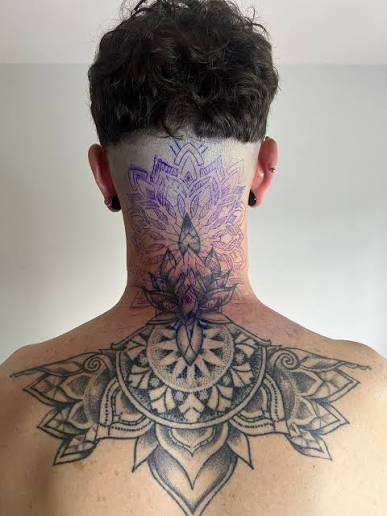
Overlooked Insight: How Body Movement Shapes Tattoo Perception
Body movement plays a critical but often ignored role in how mandala tattoos are perceived after healing. Even perfectly symmetrical designs can appear slightly distorted depending on posture, breathing patterns, and muscle engagement, especially in the chest and sternum region where expansion is frequent.
This means that successful mandala tattoo design is not static—it is dynamic. Expert tattoo artists anticipate these changes by designing for “movement symmetry,” ensuring the tattoo maintains visual balance across multiple body states rather than a single fixed pose.
Key insight: The best mandala tattoos are designed for how the body moves, not just how it looks at rest.
Frequently Asked Questions (FAQ)
What does a symmetrical mandala center placement tattoo represent?
It represents balance, unity, and alignment, often symbolizing inner harmony and spiritual grounding when placed along the body’s central axis.
Is a sternum mandala tattoo very painful?
Yes, the sternum is considered a high-pain area due to thin skin and proximity to bone, making it more intense than arm or thigh tattoos.
Do mandala tattoos lose symmetry over time?
They can slightly soften due to skin aging and ink diffusion, but high-quality geometric designs maintain strong structural symmetry for many years.
Which placement is best for a mandala tattoo?
Chest, sternum, and spine are the most common center placements, each offering different trade-offs between pain, visibility, and long-term stability.
How long does a chest mandala tattoo take to heal?
Surface healing typically takes 2–6 weeks, but full skin stabilization can take several months depending on aftercare and individual healing speed.
Can body changes affect mandala tattoo symmetry?
Yes, significant weight or muscle changes can subtly alter symmetry perception, especially in chest-based designs.
Conclusion: The Balance Between Art, Anatomy, and Precision
A symmetrical mandala center placement tattoo represents the intersection of sacred geometry, anatomical precision, and personal expression. Its success depends not only on artistic skill but also on understanding how the human body moves, heals, and evolves over time.
When properly executed, it becomes more than body art—it becomes a structural expression of balance that evolves with the wearer while maintaining its core geometric identity.