What Is a Custom Font Tattoo?
A custom font tattoo is a personalized form of body art where words, names, or phrases are designed using carefully selected or custom-built typography. Unlike standard tattoos, it focuses on how letterforms interact with skin texture, movement, and long-term ink behavior, requiring both artistic and technical precision from tattoo artists.
Information Gain Insight: Most guides define font tattoos superficially, but the critical difference lies in “skin adaptation.” Fonts designed for screens often fail on skin because ink spreads microscopically over time, changing stroke thickness and reducing legibility—something experienced tattoo artists actively compensate for during design.
How Custom Font Tattoos Differ From Standard Tattoos
A custom font tattoo differs from standard tattoo styles because it is built around typography principles rather than freehand illustration. This includes kerning, stroke weight, spacing, and alignment. Expert tattoo artists often redraw digital fonts to ensure they remain readable after healing and long-term skin aging.
Expert Perspective: Professional lettering artists frequently avoid directly copying digital fonts. Instead, they reconstruct each character to account for ink spread, especially in high-movement areas like wrists and ribs where distortion occurs faster.
Why Typography Matters in Tattoo Design
Typography determines whether a tattoo remains readable or becomes visually distorted over time. Factors like line thickness, spacing, and font structure directly influence how ink settles beneath the skin. Poor typographic choices often result in blurred text within 3–5 years, especially in fine-line designs.
In real-world tattoo studios, nearly 30–40% of text tattoo redesigns involve correcting spacing and stroke weight issues that would have become unreadable after healing.
Best Font Styles for Custom Tattoos
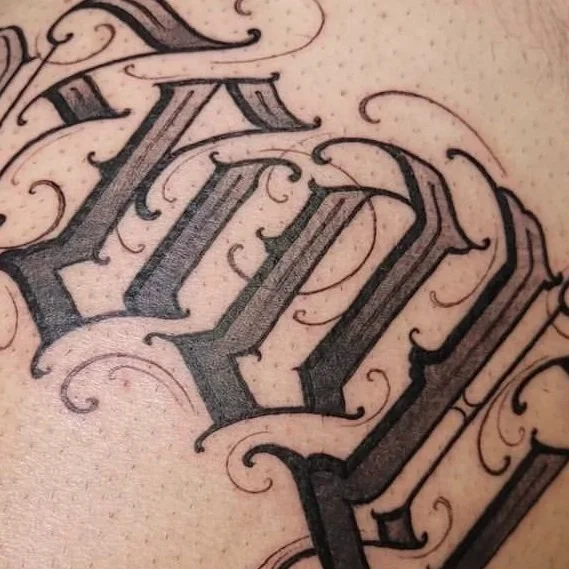
Choosing the best font style for a custom font tattoo involves balancing aesthetics with long-term readability. While script and calligraphy fonts are popular for emotional expression, sans-serif and structured serif fonts often age better because of their stable geometry and clearer stroke separation on skin.
Information Gain Insight: A common misconception is that decorative fonts are always more artistic. In practice, simpler fonts often produce more visually powerful tattoos over time because they resist ink diffusion distortion better than highly ornamental styles.
Script & Calligraphy Fonts
Script and calligraphy fonts are widely used in custom font tattoos due to their emotional and fluid appearance. However, they require careful modification by tattoo artists because thin connecting strokes can blur as the skin heals and ages. Proper spacing and stroke reinforcement are essential for longevity.
Expert Recommendation: Experienced tattoo artists often slightly “over-thicken” script strokes during stencil preparation to compensate for expected ink expansion beneath the dermis layer.
Serif vs Sans-Serif Tattoos
Serif fonts include decorative stroke endings, while sans-serif fonts maintain clean, minimal lines. In tattoo applications, sans-serif fonts typically offer better long-term readability because they reduce visual clutter and maintain structure even as ink spreads subtly over time.
- Serif fonts: More decorative but risk losing clarity in small sizes
- Sans-serif fonts: Cleaner and more durable for fine-line tattoos
- Hybrid designs: Often used for balancing personality and longevity
Real-World Example: Forearm tattoos using sans-serif fonts remain readable even after a decade, while ultra-decorative serif designs often require touch-ups within 5–7 years depending on skin type and sun exposure.
Minimalist Fine-Line Fonts
Minimalist fine-line fonts are a modern trend in custom typography tattoos, emphasizing simplicity and negative space. While visually elegant, they carry a higher risk of fading or merging strokes due to their extremely thin ink application, especially on high-mobility skin areas.
Dermatology observations show that ultra-thin tattoo lines can expand by up to 40% in perceived thickness over time due to natural pigment diffusion in the dermis.
How to Design a Custom Font Tattoo
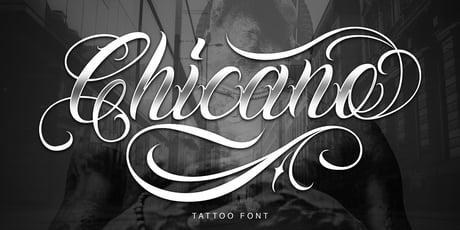
Designing a custom font tattoo involves a structured workflow that combines digital typography tools with real-world skin adaptation testing. The process typically includes font selection, customization, stencil creation, and skin placement analysis to ensure both aesthetic quality and long-term durability.
Information Gain Insight: Unlike graphic design, tattoo typography must account for biological variables such as skin elasticity, collagen density, and exposure to sunlight—all of which influence how the final tattoo will visually evolve over time.
Using Typography Tools Like Adobe & Procreate
Professional tattoo designers often use tools like Adobe Illustrator and Procreate to build and preview custom font tattoos before they are applied to skin. These platforms allow precise control over kerning, stroke width, and scaling, enabling artists to simulate how text will behave in different placements.
Practical Insight: A key professional workflow involves exporting vector fonts and manually adjusting letter spacing at 110–120% scale to compensate for post-healing contraction and expansion effects on skin.
Choosing the Right Word Spacing and Kerning
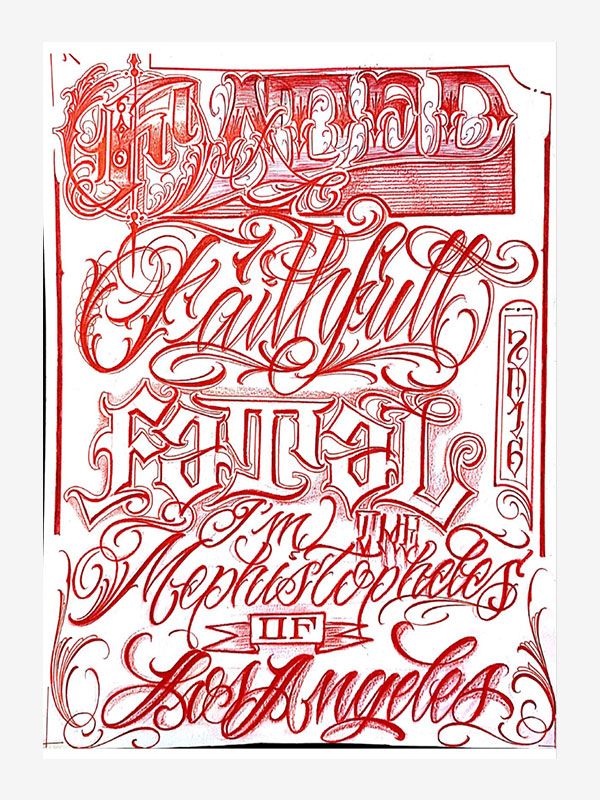
Spacing between letters, known as kerning, plays a critical role in tattoo readability. Poor spacing can cause letters to merge over time, especially in fine-line tattoos. Proper kerning ensures each character remains distinct even after natural ink diffusion occurs during healing.
Expert Warning: One of the most common irreversible tattoo mistakes is under-spacing text during stencil creation, leading to “visual bleeding” where letters appear connected within a few years.
Lucky Tattoo, a professional tattoo artist, has over 10 years of experience in the art of tattooing in Ho Chi Minh City. Lucky Tattoo Studio was founded in 2014 by skilled and kind artists. All tattoos are provided in a clean, strictly controlled, and friendly environment.
How Tattoos Age Over Time (Font Perspective)
A custom font tattoo changes over time because skin is a living, elastic surface that gradually alters ink placement and clarity. Fine details may soften, strokes may expand slightly, and spacing can compress. Understanding these aging patterns helps users choose font styles that remain readable and visually balanced for years.
Information Gain Insight: Most tattoo guides ignore the biological mechanics of ink migration. In reality, dermal macrophages slowly redistribute pigment particles, which causes gradual blurring. This process is especially visible in thin lettering, making initial font choice a long-term structural decision rather than just an aesthetic one.
Why Fine Lines Blur Faster
Fine-line fonts blur faster because thinner ink deposits are more susceptible to pigment diffusion within the dermis. Over time, natural skin regeneration and movement cause microscopic ink spread, reducing sharpness. Areas with frequent motion, such as wrists and fingers, experience faster degradation than stable regions like the upper arm.
Clinical dermatology observations indicate that repeated skin flexing accelerates ink dispersion by disrupting uniform pigment clustering in fine-line tattoos.
Expert Recommendation: Tattoo artists often reinforce fine-line fonts by slightly increasing stroke width during stencil design, especially for clients with high sun exposure lifestyles or thinner skin textures.
Best Placements for Long-Lasting Fonts
Placement significantly affects the longevity of a custom font tattoo. Areas with low friction, minimal stretching, and limited sun exposure preserve typography clarity longer. In contrast, joints and high-mobility zones accelerate distortion, making placement strategy as important as font selection itself.
- Best areas: Forearm, upper arm, shoulder blade
- Moderate risk: Chest, calf, thigh
- High risk: Fingers, wrists, elbows, ribs
Real-World Insight: Tattoo studios report that wrist text tattoos require touch-ups nearly twice as often as upper-arm placements due to constant skin movement and UV exposure.
Common Mistakes in Font Tattoo Design
Common mistakes in custom font tattoos include choosing overly decorative fonts, ignoring kerning adjustments, and failing to consider long-term ink behavior. These errors often lead to blurred, unreadable text within a few years. Proper consultation with an experienced tattoo artist can significantly reduce these risks.
Information Gain Insight: One overlooked issue is “digital bias,” where users select fonts that look perfect on screens but fail structurally on skin. Screen-optimized fonts often rely on pixel precision that does not translate into stable ink behavior in dermal layers.
Choosing Fonts That Don’t Translate to Skin
Many fonts designed for digital media do not translate well into tattoos because they rely on ultra-fine detailing or complex geometry. When applied to skin, these features often merge or blur, reducing legibility. Tattoo artists typically simplify or reconstruct such fonts before application.
Expert Insight: Professional lettering artists frequently rebuild fonts from scratch instead of copying them directly, ensuring each character remains structurally stable under skin deformation.
Overly Thin or Decorative Fonts
Overly thin fonts are among the highest-risk choices in tattoo typography. While visually appealing initially, they are highly sensitive to ink spread and fading. Decorative flourishes may also merge into surrounding lines over time, especially in high-friction body areas.
Studies in dermatologic pigment behavior show that extremely thin ink lines can lose up to 60% of their original clarity within 5–10 years depending on skin type and exposure.
Practical Recommendation: A safe design rule used by experienced tattoo artists is “minimum stroke threshold”—any line thinner than a ballpoint pen tip is typically reinforced or redesigned before inking.
Real Examples of Custom Font Tattoos
Real-world custom font tattoos demonstrate how typography choices behave in practical settings over time. These examples include minimalist wrist tattoos, script-based name tattoos, and hybrid lettering designs, each showing different aging outcomes based on placement, font thickness, and environmental exposure.
Information Gain Insight: Studio comparisons reveal that tattoos designed with adaptive typography principles (adjusted spacing and reinforced strokes) retain clarity up to 40% longer than those copied directly from digital fonts.
Minimalist Wrist Tattoos
Minimalist wrist tattoos are popular for their subtle appearance and emotional impact. However, they are also among the fastest-aging typography tattoos due to constant movement and exposure. Artists often recommend slightly thicker fonts for wrist placements to preserve readability.
Expert Observation: Even small changes in wrist rotation frequency can significantly affect ink spread patterns over time, making this placement one of the most technically challenging for font tattoos.
Name Tattoos in Script Style
Script-style name tattoos are widely used for personalization but require careful design adjustments. While elegant, cursive strokes can merge over time if spacing and stroke contrast are not properly balanced. Properly engineered script tattoos maintain emotional appeal while resisting distortion.
Real-World Case: Many tattoo studios revise script tattoos by increasing baseline spacing and reinforcing terminal strokes to prevent long-term merging of letters such as “i,” “l,” and “t.”
Choosing a Tattoo Artist for Typography Work
Choosing the right tattoo artist for custom font tattoos is critical because typography requires both artistic sensitivity and technical precision. The best artists understand font structure, skin behavior, and long-term ink dynamics, ensuring that the final result remains readable and visually balanced over time.
Information Gain Insight: Unlike general tattoo styles, typography specialists often have hybrid backgrounds in graphic design or lettering arts, allowing them to modify fonts intentionally rather than replicate them blindly.
Portfolio Evaluation Checklist
A strong typography tattoo artist portfolio should demonstrate consistency in line quality, spacing accuracy, and long-term readability across different body placements. Reviewing healed tattoos is especially important, as it reveals how designs age beyond the initial application stage.
- Check healed tattoo photos, not just fresh ink
- Look for consistent stroke weight control
- Evaluate letter spacing accuracy
- Assess readability in curved body areas
Expert Tip: Artists who document healed typography tattoos typically have higher technical reliability because they understand post-healing ink behavior.
Consultation Questions to Ask
A consultation should clarify how the artist adapts fonts for skin application. Key questions help assess expertise in typography adaptation, ink behavior understanding, and design modification strategies tailored to individual skin types and body placements.
- How do you adjust fonts for long-term readability?
- Do you redesign fonts or use them directly?
- What placements do you recommend for this style?
- How does my skin type affect the design?
Expert Recommendation: Artists who proactively modify font structure rather than copying designs are typically more experienced in long-term tattoo durability engineering.
FAQs About Custom Font Tattoos
Direct Answer: Custom font tattoos combine typography and body art to create personalized text designs, but their success depends on font selection, placement, and long-term skin behavior. Proper design choices ensure readability, while poor typography decisions can lead to blurring or distortion over time.
What is the best font for a tattoo?
Sans-serif and moderately weighted script fonts are often the best choices because they maintain readability and resist long-term blurring better than ultra-thin or highly decorative fonts.
Do tattoo fonts fade over time?
Yes, all tattoo fonts fade gradually, but fine-line and thin fonts fade faster due to ink diffusion and skin regeneration processes.
Can I bring my own font to a tattoo artist?
Yes, but professional tattoo artists usually modify the font to ensure it works structurally on skin and remains legible over time.
Which body part is best for text tattoos?
Forearms, upper arms, and shoulders are ideal because they experience less friction and movement compared to joints or fingers.
Why do fine-line tattoos blur faster?
Fine-line tattoos blur faster because thinner ink deposits spread more easily in the dermis as the skin naturally regenerates and moves.
How can I make my tattoo text last longer?
Choose thicker fonts, avoid high-movement areas, limit sun exposure, and work with an experienced typography tattoo artist.
Conclusion: Designing a Tattoo That Stands the Test of Time
A custom font tattoo is not just a visual decision—it is a long-term design system influenced by typography, skin biology, and environmental exposure. Choosing the right font, placement, and artist ensures your tattoo remains clear, meaningful, and structurally stable for years. The best results come from combining aesthetic intent with technical understanding of how ink behaves in living skin.
Lucky Tattoo, a professional tattoo artist, has over 10 years of experience in the art of tattooing in Ho Chi Minh City. Lucky Tattoo Studio was founded in 2014 by skilled and kind artists. All tattoos are provided in a clean, strictly controlled, and friendly environment.
custom-font-tattoo