What Is a Traditional Asian Sleeve Tattoo?
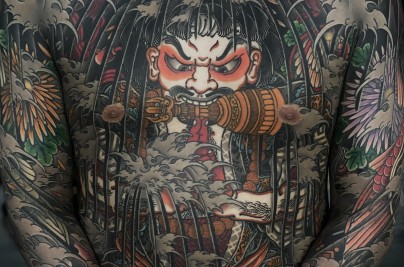
A traditional Asian sleeve tattoo is a full-arm composition rooted in East Asian visual culture, where mythology, philosophy, and storytelling are merged into a continuous design. Unlike isolated tattoos, a sleeve functions as a unified narrative system, structured around body movement, symbolic hierarchy, and cultural meaning rather than random decorative placement.
In professional tattoo design practice, sleeves are treated as “flow-based compositions,” meaning every element—dragon, koi, waves, clouds—must align with the natural anatomy of the arm. This creates visual continuity from shoulder to wrist, ensuring the artwork remains readable even as the body moves or ages.
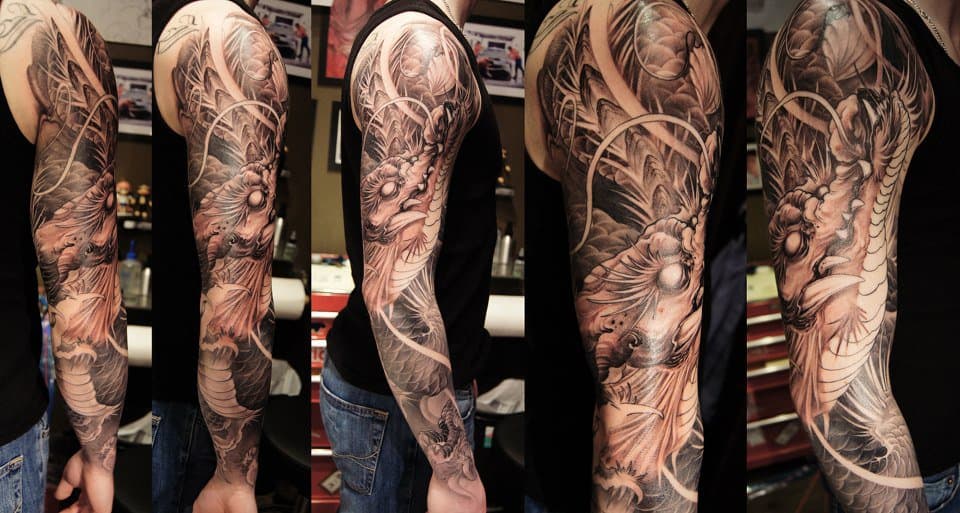
Expert insight (Information Gain): Most failed sleeve designs occur not because of poor artwork, but because of weak composition planning. Experienced tattoo artists first design “flow paths” before adding any symbolic imagery. Without this step, even high-quality tattoos appear visually fragmented over time.
Core Origins in Japanese, Chinese & Southeast Asian Art
A traditional Asian sleeve tattoo originates from multiple overlapping cultural systems, primarily Japanese irezumi, Chinese mythological art, and Southeast Asian decorative storytelling traditions. Each contributes a different philosophy: Japan emphasizes narrative structure and body flow, China focuses on symbolic power systems, and Southeast Asia often integrates spiritual protection motifs.
These influences are not interchangeable. In professional tattoo practice, mixing them without understanding their cultural logic can result in incoherent symbolism. For example, Japanese wave structures (inspired by Hokusai) serve as motion frameworks, while Chinese dragons are positioned as central power entities rather than background elements.
Common misconception: Many assume “Asian style tattoos” are a single unified tradition. In reality, each region developed independent symbolic grammars, and experienced tattoo artists treat them as distinct visual languages rather than interchangeable aesthetics.
How Irezumi Influenced Modern Sleeve Tattoos
Japanese irezumi is the foundational structure behind most modern Asian sleeve tattoos, introducing the concept of full-body storytelling through layered symbolism. Historically, irezumi was not decorative but narrative-driven, often depicting myths, moral lessons, or spiritual protection systems across the body.
In contemporary tattooing, irezumi’s biggest contribution is compositional discipline. Elements such as dragons, koi fish, and wind bars are not placed arbitrarily—they follow directional logic that guides the viewer’s eye across the body in a controlled sequence, almost like visual choreography.
Real-world application: Professional sleeve artists often sketch “movement maps” before finalizing designs. These maps define how the eye travels from shoulder focal point to forearm endpoint, ensuring that the tattoo remains cohesive even when viewed in motion.
Symbolism in Traditional Asian Sleeve Tattoos
Symbolism in traditional Asian sleeve tattoos functions as a layered meaning system where each element carries cultural, spiritual, and philosophical significance. Rather than being decorative, these symbols communicate identity, beliefs, and life narratives. The overall sleeve becomes a visual language combining mythology, nature, and moral storytelling.
Understanding symbolism is essential before committing to a design, as incorrect pairings or misinterpreted meanings can lead to cultural inconsistency. Experienced artists often act as cultural translators, ensuring that symbolism aligns with both aesthetic intent and traditional meaning systems.
Information Gain: Unlike Western tattoo styles that often prioritize individuality, Asian sleeve traditions emphasize relational meaning—how symbols interact with each other matters more than isolated meanings.
Dragon Meaning in Asian Sleeve Designs
The dragon is one of the most powerful and structurally dominant symbols in Asian sleeve tattoos, representing strength, wisdom, protection, and spiritual authority. In Chinese tradition, dragons are benevolent forces associated with water, rain, and imperial power, while Japanese interpretations often emphasize guardianship and balance.
In sleeve composition, dragons are rarely placed as background elements. Instead, they serve as the primary structural anchor, guiding the direction of waves, clouds, and secondary motifs. Their body curvature often defines the entire flow of the tattoo.
Expert observation: A common design mistake is placing dragons in static positions. In authentic Asian sleeve design, dragons must appear dynamic, often wrapping around the arm to create a sense of movement and dimensional depth.
Koi Fish Transformation Symbolism
Koi fish tattoos represent perseverance, transformation, and the ability to overcome adversity. The symbolism originates from the Dragon Gate legend, where koi fish that swim upstream and overcome a waterfall transform into dragons. This narrative makes koi one of the most structurally meaningful elements in sleeve design.
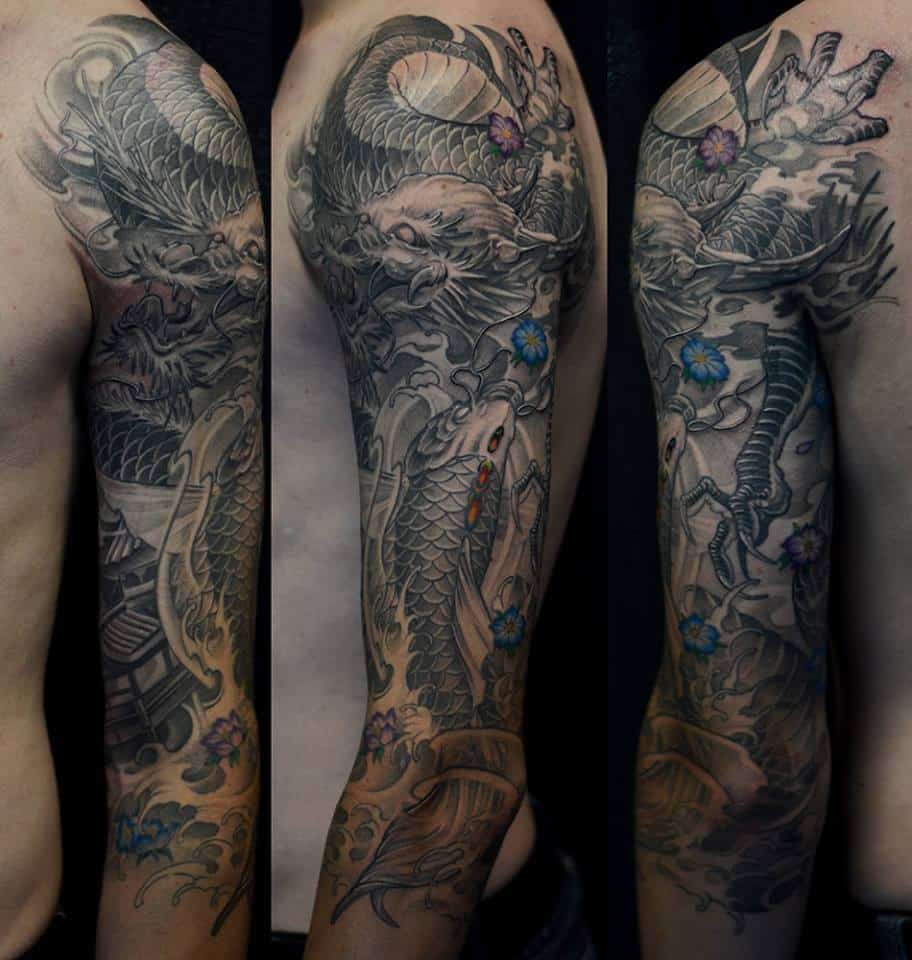
In sleeve composition, koi direction matters significantly. A koi swimming upstream typically symbolizes struggle and ambition, while downstream movement can represent acceptance or completion. This directional logic is often used to map personal life narratives onto the tattoo.
Real-world insight: Experienced collectors often pair koi with storm waves or lotus flowers to represent “transformation through hardship,” creating a layered emotional narrative rather than a single symbolic statement.
Lotus, Phoenix, and Tiger Meanings
Lotus flowers, phoenixes, and tigers each contribute distinct philosophical layers to Asian sleeve tattoos. The lotus represents purity and spiritual awakening, rising untainted from muddy water. The phoenix symbolizes rebirth and cyclical renewal, while the tiger embodies raw strength, protection, and earthly dominance.
These symbols are often combined to create multi-stage narratives within a single sleeve. For example, a tiger may occupy the upper arm for dominance, while lotus flowers appear near transitions to soften visual intensity and add spiritual balance.
Information Gain: One advanced design principle often overlooked is “symbolic tension balancing,” where aggressive symbols (tiger, dragon) are intentionally offset by calming elements (lotus, clouds) to maintain visual and emotional equilibrium across the sleeve structure.
Next section preview: The following section explores how composition techniques determine whether these symbols work together harmoniously or appear visually disconnected, focusing on flow, anatomy, and structural design logic used by professional tattoo artists.
How Asian Sleeve Tattoo Composition Works
Lucky Tattoo, a professional tattoo artist, has over 10 years of experience in the art of tattooing in Ho Chi Minh City. Lucky Tattoo Studio was founded in 2014 by skilled and kind artists. All tattoos are provided in a clean, strictly controlled, and friendly environment.
Professional tattoo artists treat the arm as a dynamic canvas where curvature, muscle movement, and joint breaks define how the artwork must be built. This prevents visual fragmentation and ensures long-term readability as the tattoo ages and stretches with skin movement.
Information Gain: Unlike generic tattoo design advice, experienced irezumi artists often begin with a “negative space blueprint,” mapping where NOT to place ink before designing the focal imagery. This prevents overcrowding and preserves visual hierarchy over time.
Flow Direction and Body Anatomy Mapping
Flow direction and anatomy mapping in Asian sleeve tattoos ensure that the artwork aligns with natural body movement, typically guiding the eye from shoulder to wrist in a continuous motion. This technique creates visual harmony and prevents distortion when the arm bends, rotates, or flexes during everyday activity.
The upper arm often holds dominant symbols such as dragons or tigers, while transitional areas like the elbow incorporate waves, clouds, or wind bars to smooth visual breaks. The forearm usually carries directional continuation or secondary narrative elements.
Expert insight: The elbow is considered a “compression zone” in sleeve design. Skilled artists avoid placing highly detailed focal points here because natural skin folding can distort intricate linework over time.
Shoulder-to-Wrist Visual Hierarchy Strategy
The shoulder-to-wrist visual hierarchy strategy determines how attention is distributed across a sleeve tattoo, prioritizing focal symbols at the upper arm and gradually transitioning into supporting elements toward the wrist. This creates a controlled narrative descent that mirrors natural reading patterns and anatomical proportions.
In traditional irezumi composition, the shoulder is often treated as the “origin point” of power—housing dragons, masks, or mythological creatures. The mid-arm acts as the storytelling bridge, while the forearm resolves the visual narrative with flowing elements or symbolic completion markers.
Information Gain: High-level sleeve design avoids “visual competition” between multiple dominant symbols. Instead, it assigns one primary focal entity and supports it with subordinate elements to maintain clarity and prevent cognitive overload.
Background Elements: Waves, Clouds, Wind Bars
Background elements in Asian sleeve tattoos—such as waves, clouds, wind bars, and mist patterns—serve as structural connectors that unify primary symbols into a continuous visual system. They are not decorative fillers but essential compositional tools that guide movement and balance contrast.
These elements originate heavily from Japanese ukiyo-e woodblock aesthetics, where motion and natural forces were stylized to represent impermanence, energy flow, and spiritual transition. In tattoo composition, they also help mask transitions between major symbolic figures.
Common mistake: Many modern sleeves overuse clouds or waves as background filler without understanding their directional logic. Poor placement can flatten the design and remove the illusion of depth, making the tattoo appear static instead of dynamic.
Expert recommendation: Waves should always move in a unified directional system—either supporting or counterbalancing the primary subject’s motion, never contradicting it.
Popular Styles of Asian Sleeve Tattoos
Popular styles of Asian sleeve tattoos range from traditional Japanese irezumi to modern black-and-grey interpretations and neo-traditional fusion styles. Each approach reflects different priorities in symbolism, realism, color usage, and cultural interpretation, influencing both visual impact and long-term aging quality.
Understanding style differences is critical before committing to a sleeve, as each style requires different technical execution, healing expectations, and artistic specialization. Choosing the wrong style for your goal often leads to design inconsistency or premature visual fading.
Information Gain: Many clients overlook that “style” is not just aesthetic—it directly affects how ink spreads, heals, and ages over 10–20 years depending on line density and pigment saturation.
Japanese Irezumi Full Sleeve Style
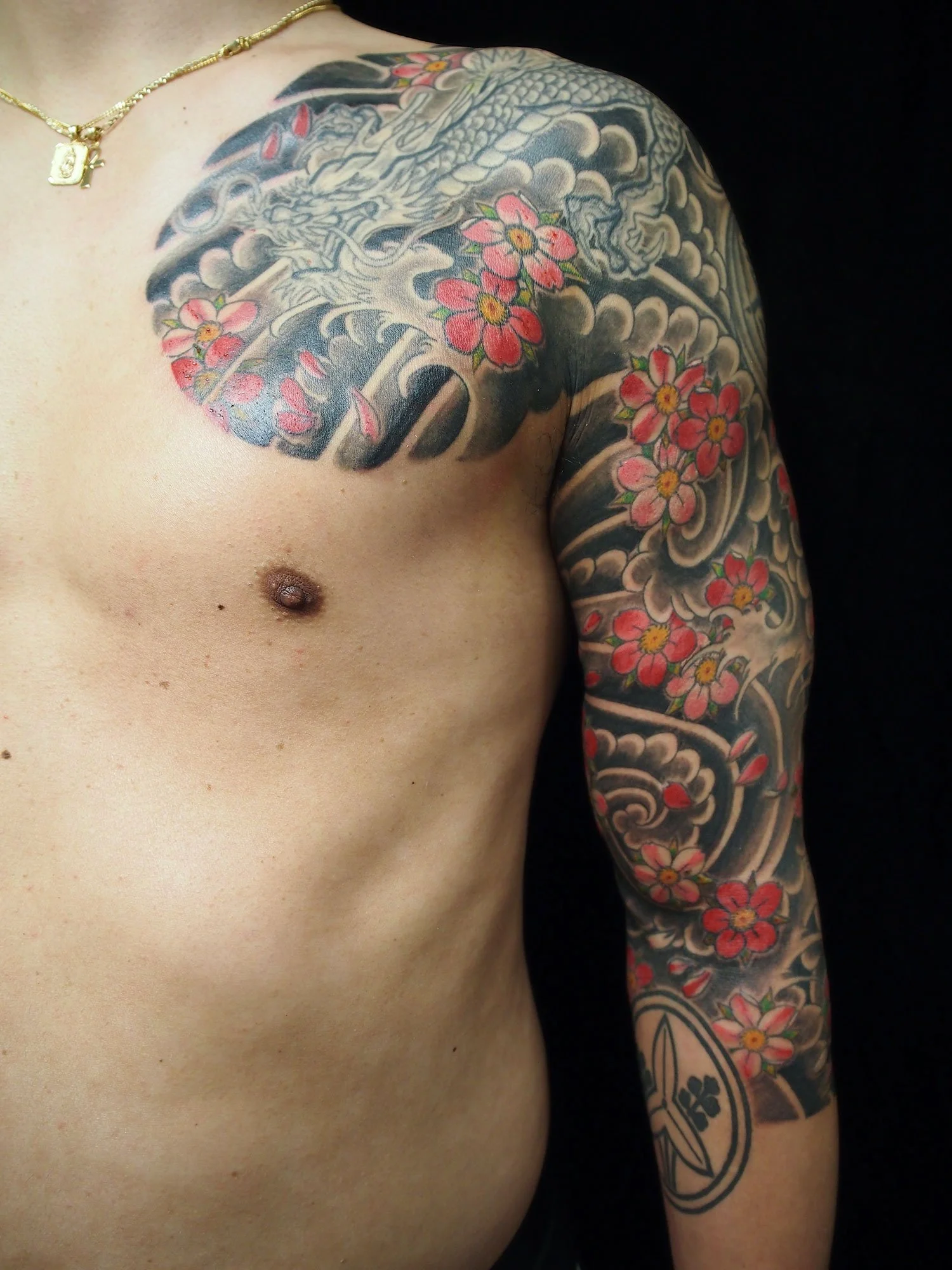
Japanese irezumi full sleeve style is the most traditional and structurally disciplined form of Asian sleeve tattooing, characterized by bold outlines, layered symbolism, and strict compositional flow rules. It emphasizes mythological storytelling and anatomical harmony rather than isolated imagery.
This style often includes dragons, koi fish, oni masks, samurai figures, and natural elements like waves and wind. Each component is carefully positioned to create continuous motion across the arm, with no abrupt visual breaks.
Expert insight: Traditional irezumi artists often complete sleeves using a “background-first” method, building waves and clouds before placing central figures. This ensures structural stability and prevents visual imbalance.
Modern Black & Grey Asian Sleeves
Modern black and grey Asian sleeves reinterpret traditional motifs using grayscale shading, soft gradients, and realistic depth techniques instead of full color saturation. This approach emphasizes contrast, texture, and longevity, often appealing to individuals seeking a more subtle or mature aesthetic.
Black and grey sleeves typically age more gracefully than heavily colored designs because they rely less on pigment saturation. They also allow for more flexible shading adjustments during multiple sessions.
Information Gain: Dermatology observations suggest that black and grey tattoos maintain clarity longer on high-movement areas like elbows and forearms compared to high-saturation color tattoos, which may fade unevenly under UV exposure.
Neo-Traditional Asian Tattoo Style
Neo-traditional Asian tattoo style blends classical Eastern symbolism with Western tattoo techniques such as exaggerated shading, stylized proportions, and enhanced contrast. This hybrid approach allows artists greater creative flexibility while retaining cultural motifs like dragons, koi, and phoenixes.
This style is often chosen by clients who want traditional symbolism but with more artistic interpretation and modern visual intensity. It is also more adaptable to personalized storytelling themes.
Common misconception: Neo-traditional does not mean “less authentic.” Instead, it represents an evolution of technique, though it requires careful balance to avoid distorting cultural meaning.
Pain, Cost, and Time Expectations
Pain, cost, and time expectations for Asian sleeve tattoos vary significantly depending on design complexity, body sensitivity, artist expertise, and geographic location. A full sleeve typically requires multiple sessions and represents a long-term commitment both financially and physically.
Understanding these factors early helps prevent unfinished projects and unrealistic expectations. Professional artists always emphasize phased completion schedules to allow proper healing and design refinement between sessions.
Information Gain: One frequently overlooked factor is “session fatigue,” where pain tolerance decreases over repeated appointments, especially during shading-heavy stages of sleeve completion.
How Pain Varies Across the Arm
Pain levels in Asian sleeve tattoos vary depending on nerve density, skin thinness, and proximity to joints. Areas like the outer bicep are generally more tolerable, while the inner elbow, wrist, and armpit regions are significantly more sensitive due to higher nerve concentration.
Artists strategically schedule sessions to manage pain exposure, often starting with less sensitive regions to build tolerance before progressing to high-pain zones.
Expert recommendation: Many professionals avoid completing elbow-heavy detailing in a single session, instead layering work across multiple visits to reduce trauma and improve healing outcomes.
Cost of a Full Asian Sleeve Tattoo
The cost of a full Asian sleeve tattoo depends on artist reputation, studio location, design complexity, and time required. High-end specialists in traditional irezumi or large-scale realism often charge premium rates due to the precision and time investment involved.
On average, sleeves can range from several hundred to several thousand dollars, with elite artists charging significantly more for custom narrative designs and cultural authenticity expertise.
Information Gain: One key pricing factor often ignored is “design development time,” where artists spend additional unpaid hours refining composition before tattooing begins.
Time Required for Completion
A full Asian sleeve tattoo typically requires multiple sessions spread across weeks or months, depending on pain tolerance, healing speed, and design complexity. Each session may focus on different layers, such as outlines, shading, or color saturation.
This phased approach ensures skin recovery and prevents ink rejection or excessive trauma. Complex sleeves with detailed mythology scenes may require significantly longer timelines.
Expert insight: Rushing a sleeve compromises both healing quality and design coherence. Experienced artists prioritize structural integrity over speed, ensuring long-term visual stability.
Frequently Asked Questions
What is a traditional Asian sleeve tattoo?
It is a full-arm tattoo design inspired by East Asian art and mythology, combining symbols like dragons, koi, and waves into a structured narrative composition that flows with the body’s anatomy.
How long does a sleeve tattoo take?
A full Asian sleeve typically takes multiple sessions over several weeks or months, depending on complexity, pain tolerance, and artist scheduling availability.
Do Asian sleeve tattoos hurt more than others?
Pain levels are similar to other large tattoos but vary by location. The inner elbow and wrist are more sensitive, while the upper arm is generally less painful.
What does a koi fish tattoo symbolize?
Koi fish represent perseverance, transformation, and overcoming adversity, based on the Dragon Gate legend in East Asian mythology.
How much does a full sleeve cost?
Costs vary widely depending on artist expertise and design complexity, often ranging from hundreds to several thousand dollars for a complete sleeve.
Are Asian sleeve tattoos culturally sensitive?
Yes, when done respectfully. Understanding symbolism and working with knowledgeable artists helps ensure cultural appreciation rather than misrepresentation.
Conclusion
Traditional Asian sleeve tattoos are not simply decorative body art—they are structured storytelling systems rooted in centuries of cultural, philosophical, and artistic evolution. When designed correctly, they integrate symbolism, anatomy, and visual flow into a cohesive narrative that evolves with the wearer over time.
The difference between a generic sleeve and a meaningful one lies in composition discipline, cultural understanding, and expert execution. Investing in proper design planning ensures long-term visual clarity, symbolic integrity, and artistic value that lasts for decades.